

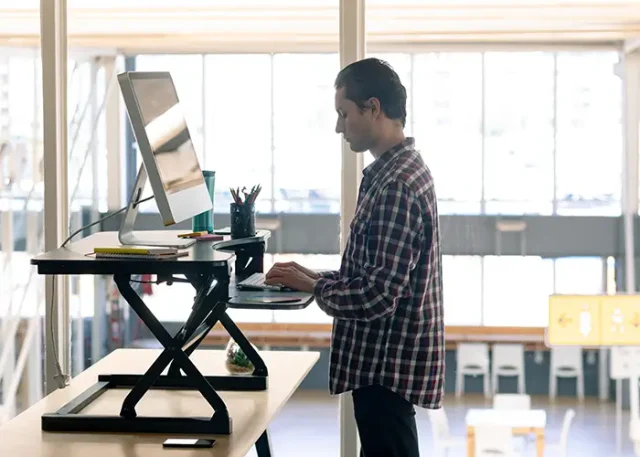
Really, work seldom remains at one single location. One might find someone using a laptop at the kitchen counter in the morning, at the hotel reception in the afternoon, at the coworking table the following day, and at the quiet corner of a short-term rental the day after. Such mobility is undoubtedly a very handy thing to have, however, generally, it has a kind of foreseeable drawback attached to it. A standing desk converter helps flip that dynamic by bringing sit-stand flexibility to almost any desk without requiring a full furniture upgrade.
Converters are designed to sit on top of an existing table and lift the work surface when standing time makes sense. This is a nice way to move a little during the day without changing a compact and easy-to-handle arrangement. For travelers, hybrid employees, and remote professionals, the appeal is simple. A familiar workstation feeling can be recreated in unfamiliar spaces.
A Smarter Way to Create a Sit-Stand Setup Anywhere
A standing desk replacement can be a commitment. It usually needs dedicated space, careful assembly, and a long-term spot in the room. Converters take a lighter approach. They place a lift-ready platform on a current desk and raise monitors and input devices to a comfortable standing height through a smooth adjustment system.
This format works well for people who cannot modify furniture. Renters often prefer upgrades that do not involve drilling or heavy installations. Shared living arrangements call for changes that can be reversed quickly. Coworking spaces rarely allow permanent customization. In each of these situations, a converter adds the benefits of sit-stand posture shifts while keeping the base desk exactly as it is.
Progressive Desk offers converter options built with everyday usability in mind, including stable construction and clean-looking designs that fit home and travel-friendly environments. A converter that lifts evenly and stays steady helps the workspace feel intentional rather than improvised. That matters during calls, writing sessions, and long stretches of focused work.
Ideal for Travel, Hybrid Work, and Compact Living
A travel schedule can make even the most organized professional feel scattered. Work happens between check-ins and layovers, or during early mornings before a meeting. Hotel desks are often the only option, and their height and surface space can vary widely. A converter brings predictability to that scenario by creating a more consistent posture setup where the trip happens.
Hybrid work adds its own challenge. Office days may offer better furniture, while home days rely on whatever was already there. A converter becomes a bridge between those environments. It supports a more uniform workflow without requiring duplicate equipment or a full desk replacement.
Small apartments also benefit. Many people avoid large standing desks because they dominate the room. A converter keeps the footprint modest. It can be lowered when not needed and paired with a dining table or compact desk without reshaping the entire space. That flexibility fits modern living where rooms serve multiple purposes.
Comfort and Productivity Without a Full Desk Upgrade
The biggest advantage of a converter is how easily it encourages posture changes. Long seated sessions can lead to stiffness and sluggish attention. Standing intervals introduce movement without forcing major schedule changes. The transition feels natural when it takes only a moment to raise the surface and keep working.
A well-designed converter also supports a more functional layout. Monitors can sit at a more suitable height. Keyboards can be positioned with better alignment. The work area can stay organized because the platform keeps essentials grouped in one place.
Converters from Progressive Desk are built to support common setups, from laptop-only workflows to monitor-based configurations. Stability is important here. A converter should feel secure at full height, especially during typing or note-taking. Smooth adjustment also matters. A lift that moves quietly helps maintain focus in shared spaces and during video calls.
When comparing options, it helps to evaluate daily needs first:
- Surface room for a laptop, keyboard, and mouse, or for a monitor and accessories.
- Weight support that matches the equipment used every day.
- An adjustment system that feels controlled and easy to operate.
- Steady performance when raised, not only when lowered.
- A design that can be stored neatly in smaller rooms if needed.
These points keep the selection process grounded in real use rather than marketing claims.
Choosing the Right Converter for Your Workspace
The best converter is the one that fits the base desk and supports the routine. Start with the available table space. The converter should sit fully on the surface without hanging over edges. Depth should allow enough room for comfortable hand placement, plus a bit of clearance for cables.
Next, consider the adjustment range. The platform should rise high enough to support a standing posture that feels natural. It should also lower enough to support seated work without forcing shoulders upward or wrists into awkward angles. A converter that covers both positions well becomes easier to use consistently.
A Workday That Adapts to the Destination
A hectic routine and constantly changing work areas don’t have to lead to bad posture. Standing desk converters make switching from sitting to standing easy in almost any setting, be it a fixed home office or a temporary arrangement. These devices provide adaptability without the hassle of tricky setup, keeping your area organized and turning position changes into an effortless routine.
With the diverse options from Progressive Desk, such a converter becomes a reliable part of a portable work setup or a compact home improvement. Ultimately, you get a workspace that adapts to each new spot, always promoting concentration, bodily comfort, and top-notch productivity.