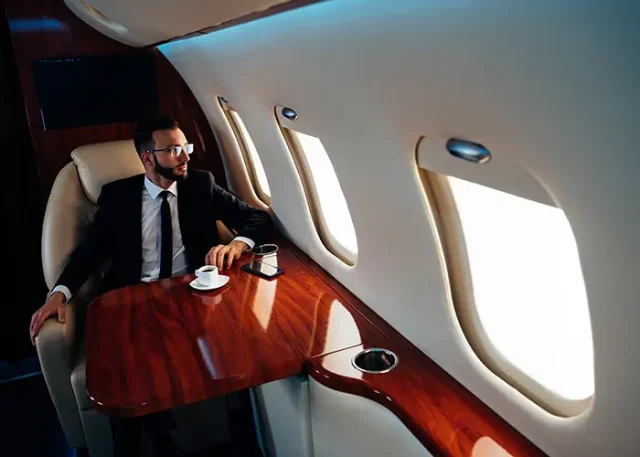
For decades, the golden curtain separating Economy from First Class was the defining line of travel luxury. To turn left upon entering an aircraft was to enter a world of warm nuts, champagne, and lie-flat seats. However, as commercial airlines have democratized access to lounges and status, and as terminals have become increasingly chaotic regardless of ticket class, that curtain has become thinner. The true luxury traveler knows that the ultimate upgrade isn’t a better seat on a crowded plane; it is the absence of the crowd altogether. This is the realm of the private charter, a mode of transport where the primary luxury is not just champagne, but control.
In the modern era of high-end travel, the distinctions between commercial carriers have blurred. Even the most exclusive commercial suites still require you to navigate the labyrinth of modern airport security, endure the unpredictability of flight schedules, and share your breathing space with hundreds of strangers. Consequently, discerning travelers are increasingly turning away from commercial schedules and navigating the landscape of private jet companies to reclaim their peace of mind. This shift is not merely about ostentation; it is a calculated decision to opt out of the systemic inefficiencies that plague modern mass transit.
The Currency of Time
If luxury is defined by scarcity, then time is the most luxurious asset one can possess. Commercial travel is a thief of time. It demands you arrive hours before departure, subjecting you to the indignity of removing your shoes and belt, scanning your laptop, and waiting at a gate. Private aviation returns those hours to you. The fundamental promise of the charter is that the aircraft waits for you; you do not wait for the aircraft.
Imagine a departure schedule that is set not by an airline algorithm, but by when you finish your morning coffee. You drive directly to the tarmac, often pulling your vehicle right up to the aircraft’s steps. The pilot greets you, your luggage is loaded in moments, and you are airborne ten minutes after arrival. On a round trip, this efficiency saves anywhere from four to six hours of “dead time.” Over a year of travel, this accumulates into days – entire days of life reclaimed from the sterile waiting rooms of commercial airports. For the high-net-worth individual or the C-suite executive, this time is not just leisure; it is quantifiable value.
Accessing the Hidden World
Beyond the saving of time, there is the issue of geography. Commercial airlines operate on a hub-and-spoke model, utilizing massive aircraft that require long runways and extensive infrastructure. This limits them to approximately 500 major airports worldwide. Private jets, with their diverse range of sizes and capabilities, have access to over 5,000 airports. This difference is not just a statistic; it changes the very nature of the destination.
Consider a ski trip to the French Alps. Flying commercially might mean landing in Geneva or Lyon and then facing a two-hour drive up winding mountain roads to reach Courchevel. A private charter, however, can land directly at the Courchevel Altiport, placing you on the slopes minutes after touchdown. The same logic applies to island getaways. While commercial flights land at major hubs requiring ferry transfers, a smaller charter can land on short island strips in the Caribbean or the Greek Isles. You arrive at the destination, not a transportation hub near the destination. This precision eliminates the “last mile” fatigue that often ruins the first day of a vacation.
The Sanctuary in the Sky
Once airborne, the value proposition shifts to privacy. In a world of constant surveillance and social media, the private cabin is one of the last true sanctuaries. For business travelers, this is critical. Discussing a merger or a sensitive legal matter is impossible in a commercial business class pod, where a competitor or a journalist could be sitting across the aisle. On a charter, the cabin is a secure boardroom. You can speak freely, work with confidential documents, and hold meetings with the assurance of total discretion.
For leisure travelers, the privacy means the freedom to be oneself. If you want to sleep, the cabin can be configured into a bedroom with proper linens, not just a reclining seat. If you are traveling with family, the space becomes a living room. Children can play, move around, and be children without the glare of annoyed passengers. The social friction of travel is erased. You are not managing your behavior to suit the environment; the environment is managed to suit you.
Gastronomy Without Limits
The culinary experience on commercial flights, even in top tiers, is fundamentally limited by logistics. Meals are reheated, mass-produced, and selected from a rigid menu. Private aviation breaks these chains. The menu on a charter flight is whatever you desire it to be. If you crave sushi from a specific restaurant in London before flying to New York, the concierge can arrange for it to be picked up and served on board. If you have specific dietary requirements or a preference for a particular vintage of Bordeaux, the galley is stocked accordingly.
This is not just about indulgence; it is about feeling at home. The ability to eat what you want, when you want, helps ground the traveler. You are not forced to eat dinner at 5 PM because that is when the service cart rolls through. You eat when you are hungry. This bespoke approach extends to the service itself. Crews on frequent charters often get to know the passengers, learning their preferences for lighting, temperature, and service style – whether they prefer attentive refills or total solitude.
Wellness and Physiology
One of the most overlooked aspects of private aviation is the physiological benefit. Most commercial airliners are pressurized to an altitude of 8,000 feet. This lower pressure, combined with extremely dry recycled air, contributes significantly to jet lag and fatigue. Modern private jets, particularly newer long-range models like the Gulfstream G650 or the Bombardier Global 7500, are capable of maintaining a much lower cabin altitude – often around 3,000 to 4,000 feet – even when cruising at 45,000 feet.
This difference may sound technical, but the physical result is profound. Your heart and lungs work less to oxygenate your blood. You arrive feeling more alert, less dehydrated, and with fewer headaches. Furthermore, these aircraft often feature advanced lighting systems that can be programmed to sync with your destination’s time zone, gently shifting your circadian rhythm while you fly. For the traveler who needs to step off the plane and immediately attend a gala or a board meeting, this physiological edge is priceless.
Companions of All Species
For pet owners, commercial travel is a nightmare. Putting a beloved dog or cat in the cargo hold is a stressful, risky proposition that many refuse to consider. Even if small pets are allowed in the cabin, they must remain in a carrier under the seat – a cramped and terrifying experience for the animal. Private aviation recognizes pets as family members. On a charter, your golden retriever can walk onto the plane with you, curl up on the rug, or sit on the sofa. There are no size restrictions and no trauma.
This freedom changes the scope of long-term travel. It allows families to relocate for the summer or take extended holidays without the guilt of leaving pets behind or the worry of their safety during transport. It is a level of humanity that commercial aviation simply cannot provide due to scale and regulation.
The FBO Experience
The experience of private travel begins long before the wheels leave the ground, at the Fixed Base Operator (FBO). These are the private terminals dedicated to general aviation. Unlike the frantic, fluorescent-lit halls of commercial terminals, FBOs are quiet havens of calm. There are no public announcements blaring, no queues, and no retail clutter. The staff knows your tail number and your car. You might spend only five minutes in the FBO before boarding, but those five minutes are defined by peace.
In some locations, the FBO is a destination in itself, offering private suites, showers, and conference rooms. However, the true luxury of the FBO is how little time you spend there. It is designed for throughput, not holding. It acknowledges that the goal of travel is movement, not waiting. This stands in stark contrast to the commercial model, which is built around “dwell time” to maximize retail spending.
The Flexibility of the “Go-Now”
Perhaps the most intoxicating element of charter travel is the flexibility. Life is unpredictable. Meetings run late, weather shifts, and moods change. On a commercial ticket, changing a flight is a bureaucratic ordeal involving fees and availability checks. On a charter, the schedule is fluid. If you are enjoying a lunch in Rome and decide to stay an extra three hours, you simply notify the crew. The plane waits.
This agility extends to mid-flight decisions as well. If weather prevents a landing in one city, or if a sudden business opportunity arises in another, the flight plan can often be altered in the air (dependent on fuel and permits). This “go-now” capability allows for a type of spontaneity that is usually impossible for the modern traveler. It restores a sense of adventure to the journey, knowing that you are not locked into a rigid grid of logistics.
The Future of Sustainable Luxury
It is impossible to discuss private aviation without addressing the environmental impact. The industry is acutely aware of its carbon footprint and is innovating faster than the commercial sector in many regards. The luxury traveler of today is increasingly conscious of sustainability. Leading charter brokers and operators now offer robust carbon offsetting programs, where the emissions of a specific trip are calculated and offset through investments in forestry or renewable energy projects.
More importantly, the adoption of Sustainable Aviation Fuel (SAF) is being driven by the private sector. SAF can reduce lifecycle greenhouse gas emissions by up to 80% compared to conventional jet fuel. Because private travelers are often willing to pay the premium for these greener fuels, the sector is becoming a testing ground for technologies that will eventually benefit all aviation. The future of luxury flight is silent, efficient, and increasingly green.
The Value Proposition
Ultimately, the choice to fly private is a choice to prioritize the quality of one’s life. It is an investment in personal energy, family comfort, and professional efficiency. While the cost is significantly higher than commercial first class, the return on investment – measured in hours saved, stress avoided, and privacy maintained – is incalculable for those who can afford it.
In a world that is becoming louder, more crowded, and more regulated, the private charter remains a bastion of personal liberty. It reminds us that travel was once about the romance of the journey, not just the endurance of the transit. It is the architecture of silence in a noisy world, a rare space where the traveler is truly the master of their own destiny.