
Few countries offer such an extraordinary concentration of civilizations as Türkiye. From the Hittites and Greeks to the Romans, Byzantines, Seljuks, and Ottomans, every era has left its mark across the country. Among its most remarkable cultural routes is the journey through the Seven Churches of Revelation, a collection of ancient Christian communities located in western Türkiye that today form one of the world’s most significant archaeological and historical itineraries.
While these sites are deeply connected to early Christianity through the Book of Revelation in the New Testament, they are equally compelling as destinations that tell the story of trade, architecture, philosophy, urban planning, and cultural exchange in the ancient Mediterranean. Visiting them is not only a spiritual experience but also an immersion into more than two millennia of human history.
A Cultural Corridor Across Western Türkiye
The Seven Churches are spread across the modern provinces of İzmir and Manisa, regions where the Aegean coastline meets fertile valleys, vineyards, mountain landscapes, and some of the most important archaeological sites in the world. Together, they reveal how cities flourished under Greek and Roman influence while serving as crossroads connecting Europe and Asia.
Travelling this route offers visitors the opportunity to experience much more than ancient ruins. Local markets, traditional villages, regional cuisine, museums, and UNESCO World Heritage Sites create a rich cultural journey that blends the past with contemporary Turkish life.
Ephesus: The Great Metropolis of Antiquity
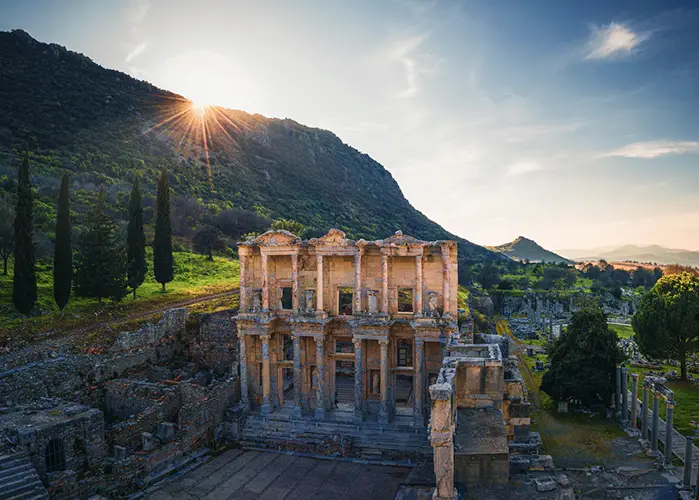
Perhaps the most celebrated stop on the route, Ephesus was one of the largest and wealthiest cities of the Roman Empire. Today, it is recognised as a UNESCO World Heritage Site and stands among the best-preserved classical cities anywhere in the world.
Walking through its marble streets reveals monumental structures such as the iconic Library of Celsus, the Great Theatre capable of seating around 25,000 spectators, Roman baths, temples, public squares, and elegant homes decorated with intricate mosaics.
Beyond its archaeological grandeur, Ephesus represents centuries of cultural exchange. Merchants from across the Mediterranean once gathered here, making the city a thriving centre of commerce, education, and philosophy. Nearby, visitors can also explore the House of the Virgin Mary and the Temple of Artemis, one of the Seven Wonders of the Ancient World.
Smyrna: Ancient History in Modern İzmir
Modern-day İzmir, Türkiye’s third-largest city, stands on the foundations of ancient Smyrna, one of the oldest continuously inhabited settlements in the Mediterranean.
Its Agora, beautifully preserved despite centuries of earthquakes and rebuilding, offers remarkable insight into Roman urban life with its arches, courtyards, and underground galleries.
Today, İzmir perfectly illustrates how history and modern culture coexist. Visitors can spend the morning exploring archaeological remains before enjoying seaside promenades, vibrant cafés, contemporary art galleries, and one of Türkiye’s most dynamic culinary scenes. The city serves as an ideal gateway for discovering the entire Seven Churches route.
Pergamon: Innovation Above the Valley
Located near modern Bergama, Pergamon was one of antiquity’s leading intellectual capitals.
Perched dramatically on a hill overlooking the surrounding plains, its acropolis contains the remains of royal palaces, temples, one of the steepest ancient theatres ever built, and the legendary Library of Pergamon, once considered second only to Alexandria.
The city also gave its name to parchment (“pergamen”), reflecting its contribution to ancient scholarship and the preservation of knowledge. Today, visitors can explore multiple archaeological zones, including the Acropolis, the Asclepion healing centre, and Roman remains that showcase centuries of continuous development.
Thyatira: A Story of Commerce and Daily Life
Unlike some of the grand imperial cities, Thyatira, located in present-day Akhisar, offers a different perspective on the ancient world.
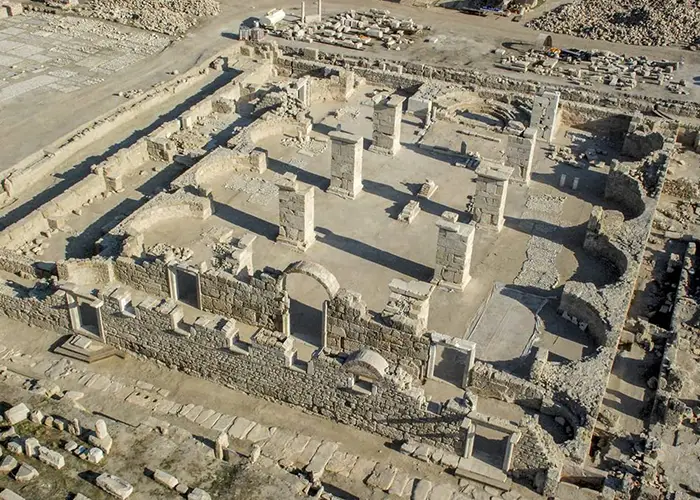
Known historically for its textile production, dye workshops, and artisan guilds, Thyatira reflects the everyday economic life that sustained the Roman Empire. Archaeological remains reveal streets, columns, basilicas, and public buildings that tell the story of a prosperous commercial centre where different cultures and traditions interacted through trade.
Its quieter atmosphere allows visitors to appreciate how ordinary communities contributed to the broader cultural landscape of the ancient Mediterranean.
The Remaining Churches: Sardis, Philadelphia, and Laodicea
The cultural route continues through three additional remarkable destinations, each representing a different chapter in Anatolia’s long history.
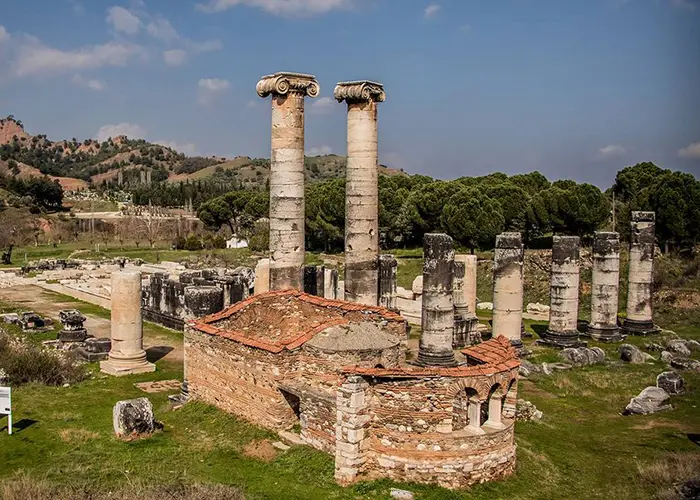
Sardis, once the magnificent capital of the ancient Kingdom of Lydia, is renowned as the city associated with King Croesus and some of the earliest coinage in human history. Its monumental gymnasium, synagogue, and Roman streets reflect centuries of prosperity and multicultural coexistence.
Philadelphia, today known as Alaşehir, preserves traces of Byzantine fortifications and early Christian heritage while remaining surrounded by vineyards that continue an agricultural tradition dating back thousands of years.
Finally, Laodicea, near Denizli, impresses visitors with one of Türkiye’s most ambitious archaeological restoration projects. Monumental avenues, theatres, temples, fountains, and churches reveal the sophistication of a city that once ranked among the wealthiest in Asia Minor.
Together, these sites create a fascinating panorama of urban development, commerce, architecture, and cultural diversity across successive civilizations.