The motor and battery receive most of the attention on an electric dirt bike, but the controller decides how those components behave together. It interprets the throttle, manages current from the battery, and determines how quickly torque builds. A motor with impressive peak output can feel abrupt or difficult to use if control is poorly calibrated. A well-tuned system can make similar hardware feel predictable across slow practice, technical climbs, and open terrain.
Riding modes are one visible part of this process. They may limit speed, change power delivery, or soften throttle response. The labels on a display reveal little unless the manufacturer explains what each mode changes. Riders should evaluate control behavior, not assume that more modes automatically mean better performance.
Throttle mapping shapes the first movement
A throttle does not have to deliver motor output in a perfectly linear relationship with hand movement. The controller can make the first part of the rotation gentle, then increase output more quickly later. This type of map may help riders maneuver at low speed without giving up full performance when the throttle is opened farther.
An aggressive map can feel exciting during a short demonstration but become tiring on rough terrain. Small hand movements caused by bumps may create unwanted surges. A progressive map gives the rider a larger usable control range and can make traction easier to manage on loose ground.
Current limits are different from speed limits
A speed-limited mode may allow strong initial acceleration before stopping assistance at a set speed. A current-limited mode can reduce the torque available throughout the range. These approaches feel different and serve different purposes. New riders may benefit from both manageable acceleration and a lower maximum speed rather than one limit alone.
Mode behavior should be tested in a clear, controlled area. Riders need to know whether a setting remains selected after the bike is turned off, whether modes can be changed while moving, and how the display communicates the active choice. Consistency matters because an unexpected return to full power can undermine the value of the feature.
Protection functions also live in the control system
The controller may coordinate startup checks, temperature protection, low-voltage behavior, and power cutoff signals. These functions protect more than performance. A throttle-reset check can prevent an unintended launch, while thermal or electrical limits may reduce output before components are damaged.
Riders should not treat protective limits as obstacles to bypass. Repeated shutdowns or reduced power can indicate excessive load, high temperature, a battery problem, or another condition that requires inspection. Changing settings without understanding the cause can move stress to a less protected component.
Reverse assist solves a specific low-speed problem
Electric drive makes controlled reverse assistance possible on some models. This is not intended for riding backward at speed. It helps move a heavy bike out of a parking position, narrow trail stop, or awkward slope where pushing with the rider’s legs would be difficult. The function should engage deliberately and operate at a limited pace.
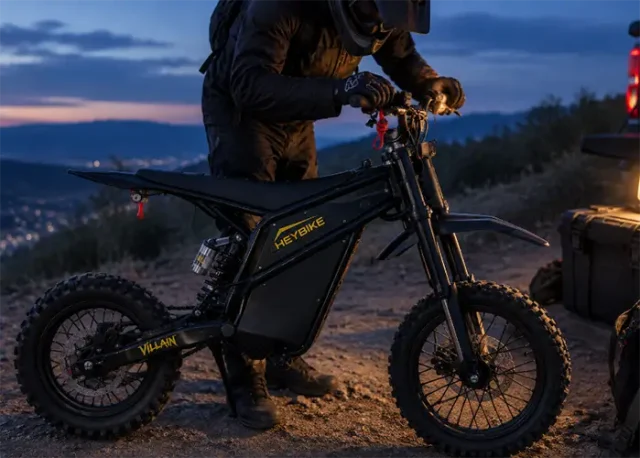
The V1 presented by heybike sports identifies a FarDriver smart controller and references multiple speed or riding modes as well as R-Turn reverse assist in its official product information. Those details show that the controller contributes to maneuvering and accessibility, not only maximum acceleration.
Software cannot fix mismatched hardware
Control tuning works within the capabilities of the battery, motor, wiring, drivetrain, tires, and brakes. A smooth map cannot create traction when the tire is unsuitable, and a higher current setting can overload components that were designed for the factory calibration. Unsupported controller modifications may also affect reliability, warranty coverage, and legal classification.
When comparing electric dirt motorcycles, look for clear descriptions of modes, startup behavior, reverse functions, and safety cutoffs. Ask whether settings are user-adjustable, factory-defined, or app-controlled. A vague reference to “smart technology” is less useful than a specific explanation of what the controller does.
Unexpected behavior needs diagnosis
Intermittent surging, delayed response, or repeated error messages should not be dismissed as personality. Stop riding and inspect the controls according to the manual. A damaged throttle, loose connector, low battery, overheated component, or activated protection function can produce behavior that feels like poor tuning.
Record the active mode, battery level, temperature, and conditions when the issue occurs. That information helps customer support or a technician separate a reproducible control problem from normal power reduction. Do not test an uncertain throttle response near traffic, people, or obstacles.
Judge control by repeatability
A good controller makes the bike respond the way the rider expects. The same throttle input should produce consistent behavior under similar conditions, mode changes should be obvious, and protection functions should communicate why output has changed. Smooth response at walking pace is often a stronger sign of careful calibration than dramatic acceleration in a straight line.
Electric dirt bike performance is therefore partly a software experience. The battery stores energy and the motor converts it, but the controller decides how the rider gains access to that force. Understanding its role leads to better comparisons and encourages riders to value usable, predictable power over a single peak number.