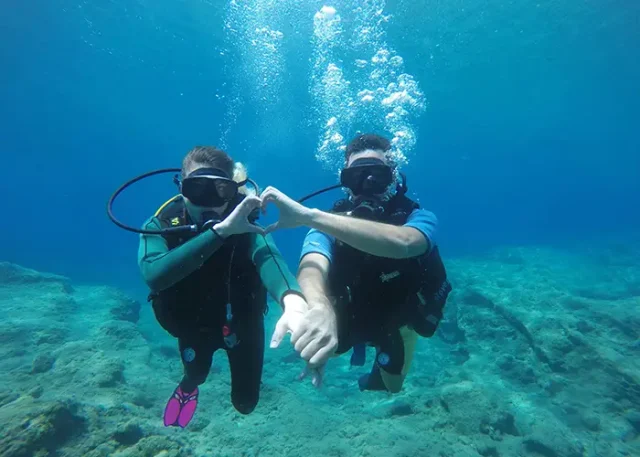
There’s a moment, just after sunset, when the Maldives seems to pause. The light softens, the atolls settle into that gentle in-between state, and the sea takes on a quieter kind of presence. It’s in this calm — that delicate shift from day to night — that many divers start to wonder what the underwater world feels like once darkness fully arrives. And naturally, people researching diving in the Maldives almost always come across whispers of its night dives: not dramatic or overwhelming, but slow, warm, and almost impossibly peaceful.
I still remember the first time I watched a group preparing for a night dive here. The sky had just turned into that muted lavender shade that seems unique to the Indian Ocean. Torches clicked on one by one, tiny columns of light cutting through the dusk. There was no rush, no nervous chatter, just a soft kind of anticipation. What surprised me, even then, was how unthreatening the whole scene felt. Night diving has a reputation — something adventurous, slightly edgy — yet in the Maldives, it somehow becomes the opposite. Calm. Grounding. Almost meditative.
It’s this atmosphere, more than anything, that makes the Maldives such an extraordinary place to experience underwater darkness for the first time.
What makes night diving in the Maldives feel so unusually calm?
If you’ve ever night-dived in cooler or more unpredictable waters, you’ll know that the first descent can be a little jarring. But the Maldives doesn’t do anything abruptly. The temperature barely shifts after sunset. The water moves slowly in many lagoons. Even the soundscape seems to quieten.
I sometimes think part of the peacefulness comes from how predictable everything feels — not in a dull way, but in a reassuring one. Warm shallows. Familiar house reefs. Slow currents that feel more like gentle breaths than anything commanding. There’s a contradiction here, perhaps: the idea of “darkness” being comforting. Yet the Maldives manages it effortlessly.
Of course, that sense of peace isn’t only environmental. The cultural rhythm plays a part too. People here move in gentle patterns; evenings unfold slowly. You feel that on the boat, or even standing waist-deep at the entry point. The night doesn’t hurry you. It welcomes you in its own time.
The atmosphere underwater after sunset
Light becomes something you carry, not something you enter
Diving during the day, you step into brightness. At night, light becomes intimate — a narrow beam extending just ahead of you, shifting with each small movement. It makes everything feel close and strangely comforting.
You begin to notice details you might have ignored in daylight: the way coral textures respond to torchlight, the delicate shimmer of plankton drifting through the beam, and those tiny particles suspended like dust motes in a sunbeam, except here they’re illuminated only by the circle of light you hold.
The reef breathes differently
Reefs have their own circadian rhythm, and at night the Maldives reveals a side that most travellers never see. Fish that dominated the scene hours earlier now tuck themselves into coral crevices, colours dulled into muted dusk tones. Meanwhile, nocturnal life rises gently from the darkness.
Octopus shifting shape and colour like a slow flicker. Crustaceans scuttling with delicate precision. Coral polyps opening in soft, petal-like patterns.
Everything feels slower, not eerie. Just… unhurried. Like the reef is stretching after a long day.
Silence becomes part of the landscape
During the day, there’s always something happening — high-pitched fish chatter, the distant hum of boats, bubbles rising in groups. But at night, that soundtrack fades.
Your breathing becomes the only rhythm you hear, steady and almost hypnotic. In many ways, this simplicity is what makes night diving here feel less intimidating. There is nothing competing for your attention. No rush of movement. No visual overload. Just presence.
Why the Maldives is especially beginner-friendly for night dives
Some destinations make night diving feel like a specialist activity. The Maldives, however, turns it into a natural extension of daytime diving — familiar sites, gentle entries, and a soft kind of progression.
Warm, welcoming water
Warmth matters more than most people realise. It calms nerves. It helps you settle more quickly. It lets beginners focus on breathing and buoyancy rather than discomfort. Even after sunset, the sea in many Maldivian atolls retains that enveloping warmth, like slipping into a softly lit pool.
House reefs that keep things simple
Many resorts sit alongside house reefs that begin just a few fin kicks from shore. These reefs offer the ideal conditions for a first night dive:
- predictable routes
- shallow depths
- sheltered water
- easy orientation
You often return to the exact site you dove that morning, which adds a layer of familiarity. There’s a small comfort in recognising coral shapes in torchlight — the mind connects the two experiences and relaxes.
Guided by instructors who know these reefs as well as daylight
Maldivian dive teams are deeply experienced with night diving. They know not only the layout of the reef but its behaviour at different times of day, the predictable movement of fish, the way light reflects off certain coral heads.
This makes the entire experience smoother, especially for beginners who might be descending into darkness for the first time. You don’t feel like you’re venturing into the unknown. You feel accompanied.
The quiet magic of marine life after dark
Night diving isn’t about drama here. It’s about slow moments of beauty — small, intimate scenes that unfold softly in front of your torch beam.
Bioluminescence: a subtle flicker in the darkness
In some parts of the Maldives, a gentle swirl of your hand is enough to spark tiny bursts of blue-green light. It’s not constant, not theatrical, but when it appears it feels like the ocean is exhaling stars.
A quiet kind of wonder.
Creatures that emerge only at night
- Octopus navigating the reef with surprising grace
- Parrotfish sleeping in mucus cocoons that shimmer faintly
- Nurse sharks drifting slowly across sand patches
- Crabs and shrimps moving with deliberate precision
There’s no chaos, no frenetic movement. Just presence and pattern.
How shadows soften the reef
Torchlight creates contrast, but it also softens edges. Coral heads appear deeper in colour; fish seem closer, yet calmer. The limited field of vision, instead of feeling restrictive, often makes divers feel more focused, more attuned to the moment.
Why Maldivian geography makes night diving uniquely peaceful
Sheltered sides of islands for quieter water
Many night dives take place on the inner side of an atoll or reef, where currents ease naturally. This reduces both physical effort and mental load — two things that help beginners relax.
Clear water even at night
The Maldives’ lagoons tend to hold clarity well into darkness. With minimal sediment and fine coral sand, even torchlight travels cleanly, creating a clear “window” into the scene ahead.
Short distances, gentle logistics
No long boat rides, no complicated planning. You often walk from the dive centre straight into the water. And when the dive ends, warmth is never far away — a short climb back into the boat or a simple, sandy walk to shore.
These small comforts shape the whole experience.
A few gentle considerations for first-time night divers
Without slipping into a safety lecture, there are quiet habits that make night diving smoother:
- Move slowly — everything feels more meaningful at that pace.
- Stay close to your buddy’s light — it’s grounding.
- Let your eyes adjust — darkness has its own language.
- Allow any initial hesitation to fade naturally.
Some divers love night diving immediately. Others take a moment. There’s no right reaction. And perhaps that’s the beauty of it — the Maldives makes space for both.
Why peace, not drama, defines night diving in the Maldives
People often expect night diving to feel intense, maybe even unsettling. But in the Maldives, it becomes something else entirely — a gentle conversation between light and shadow, water and stillness.
You notice your own breathing more. You notice the slow sway of soft corals. You notice how the darkness isn’t really dark at all, but layered with subtle, shifting tones. And somewhere in that simplicity, the experience becomes peaceful.
The Maldives doesn’t try to impress you. It doesn’t overwhelm you. It simply lets you exist underwater in one of the calmest environments imaginable.
Conclusion
When night settles over the atolls, the Maldives feels like it exhales. The sea becomes softer, the water warmer, the reef slower and somehow more open. Night diving here isn’t an adrenaline story — it’s a quiet embrace, a slow exploration of a world that reveals its beauty gently, almost tenderly.
And in the stillness of that underwater night, you realise why so many divers describe the Maldives not as dramatic, but as peaceful — a rare kind of peace that stays with you long after the beam of your torch fades.
About the author
This article was written by Kyle, a travel editor drawn to coastlines, soft underwater light, and the quiet moments that happen when the world slows down. Kyle writes reflective, experience-led features for The Traveller World Guide, exploring places where calm and curiosity meet.