Greece rewards those who take their time, and a ten-day Greece itinerary gives the country room to reveal itself properly. Athens alone could fill a week, and each of the islands covered in this itinerary has its own character, history, and allure. A week and a half gives you breathing room to move between its ancient streets and island shores. Absorb thousands of years of history one day, then trade it for caldera views and clear Aegean water the next.
Greece is at no shortage of both historic and modern places to and Booking.com’s Genius loyalty program will help your dollar go further with exclusive discounts, room upgrades, free breakfasts, and more. This Greece itinerary covers Athens, Santorini, Mykonos, and Crete, building a route that balances culture, coastline, and the kind of slow afternoons the country does best.
Day 1: Arrival in Athens and exploring the Plaka
Morning
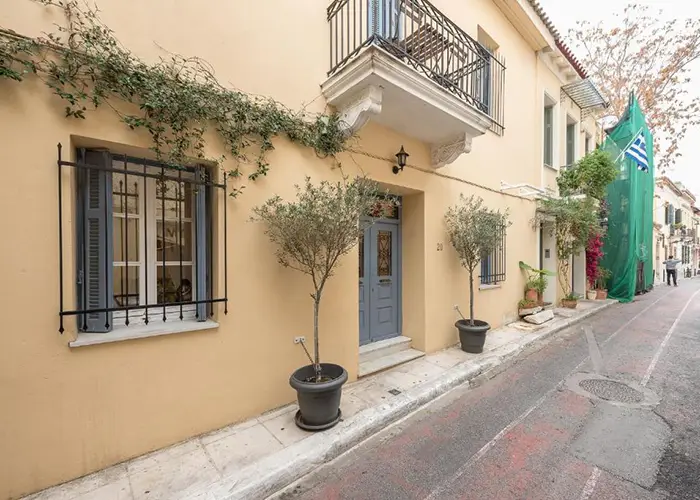
After landing at Athens International Airport (ATH), the priority is a smooth transfer to your accommodation rather than immediately cramming in sightseeing. The metro connects the airport to central Athens in around 40 minutes. Athenian Niche in Plaka Villa by Athenian Homes is both a Booking.com Genius property and Travel Proud partner in a historic Athens city center building with a garden and free WiFi for guests. Once checked in, take the time to settle and orient yourself before heading out to explore.
Afternoon
The Plaka neighborhood, nestled at the foot of the Acropolis, is one of the most walkable parts of Athens and a natural starting point. Its winding lanes are lined with Neoclassical architecture, small churches and family-run tavernas serving mezedes – small shared dishes. Monastiraki Square sits at the edge of Plaka and connects to the flea market area, where antique stalls and street food create a lively, unhurried atmosphere.
Evening
As the heat fades, find a table at one of the rooftop restaurants along Mnisikleous Street for views of the floodlit Acropolis. Dinner in Athens tends to start late—locals rarely sit down before 9:00 pm—so there’s no need to rush. Shared plates of tzatziki, grilled fish, and local wine make for a fitting first evening.
Day 2: Athens – the Acropolis and Acropolis Museum
Morning
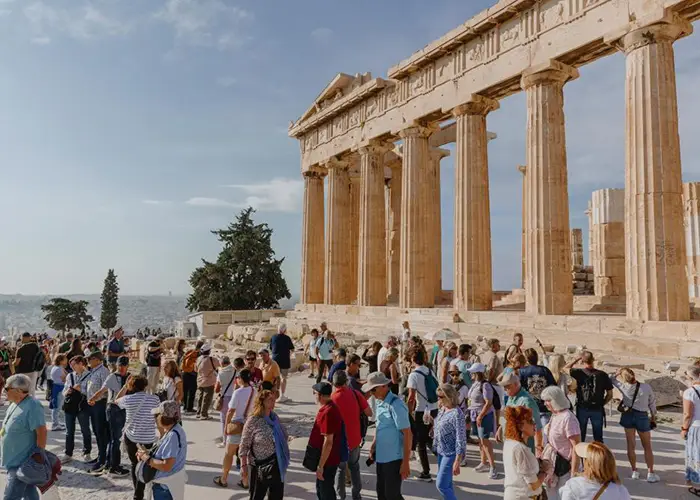
An early start is well worth it for the Acropolis and the Parthenon. Arriving before 9:00 am gives you a quieter experience and cooler temperatures before the midday sun takes hold. The Parthenon, built in the 5th century B.C.E., remains one of the most significant monuments in the Western world, with its columns and proportions still setting the standard for classical architecture more than two millennia later.
Afternoon
The Acropolis Museum, a short walk from the site entrance, is among the finest archaeological museums in the world. The top floor’s Parthenon Gallery is arranged to mirror the scale of the frieze exactly, with original sculptures displayed alongside cast replicas of those held in the British Museum. Afterward, the Koukaki neighborhood, just south of the museum, has become one of Athens’ most interesting areas for lunch, with independent cafés drawing a largely local crowd.
Evening
The ancient Agora, the commercial and civic heart of classical Athens, is best visited in the late afternoon when the light is softer and crowds have thinned. Though if you plan to visit in the winter, make sure you leave enough time to explore as the gates close around 4:30 pm. The reconstructed Stoa of Attalos houses a small archaeological museum, while the Temple of Hephaestus – one of the best-preserved ancient Greek temples – stands at the western edge of the site.
Day 3: Athens – The National Museum and a farewell dinner
Morning
The National Archaeological Museum on Patission Street holds one of the world’s most important collections of ancient Greek art. The Cycladic figurines, the Antikythera Mechanism, and the gold funeral masks from Mycenae are among the highlights of a collection that spans more than five millennia.
Afternoon
Syntagma Square offers a change of pace. The Changing of the Guard ceremony at the Hellenic Parliament takes place on the hour – the evzone soldiers’ in pleated kilts and pom-pommed shoes perform their distinctive slow-motion march. The National Garden alongside the square provides shade and a welcome retreat from the city streets.
Evening
A final dinner in Athens is worth making an occasion. The neighborhood of Psyrri, adjacent to Monastiraki, has a strong reputation for traditional Greek food in an atmospheric setting. The Artist Roof Top Bar & Restaurant, with two rooftop terraces – one for sitdown meals and one for cocktails and apps, with unbeatable views of the Acropolis and city skyline, takes you on a culinary journey of imaginative, global delicacies and modern street food.
Day 4: Athens to Santorini – Arrival and Fira
Morning
Flights from Athens to Santorini take around 45 minutes with several daily connections. Alternatively, a high-speed ferry from Piraeus reaches Santorini in around five hours – a slower crossing, but one that delivers you directly into the island’s spectacular caldera.
Damigos Caldera World is in Firostefani, just a 10-minute walk from Fira, the island’s capital, with suites thoughtfully designed to combine modern luxury and tranquility at the forefront. Balconies overlook Santorini’s volcano and the Aegean Sea, and the famous Santorini sunset.
Afternoon
Fira sits on the caldera rim with views across to the volcanic islets of Nea Kameni and Palea Kameni. The town’s cable car connects the port to the clifftop. Fira’s walkable center has independent stores and galleries, with plenty of spots to watch the light change over the water through the afternoon.
Evening
The caldera at sunset is Santorini’s signature image for good reason. The views from Fira are strong, but a walk north along the caldera path toward Firostefani and Imerovigli rewards visitors with fewer crowds and the same extraordinary panorama.
Day 5: Santorini – Oia and the island’s beaches
Morning
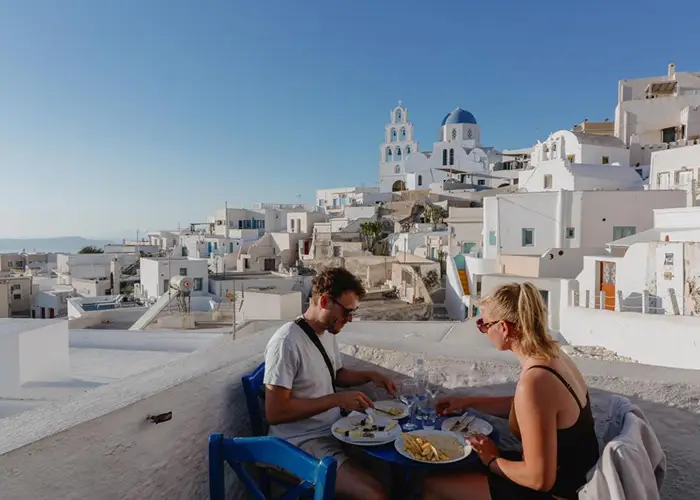
Oia, at the northern tip of the island, is one of the most photographed villages in Greece. Its blue-domed churches, white-washed cave houses, and clifftop windmills have become synonymous with the Aegean aesthetic, and arriving in the morning gives you time to explore before the midday crowds arrive.
Afternoon
Santorini’s beaches are unlike those found elsewhere in the Cyclades. The Red Beach, near ancient Akrotiri, sits below dramatic rust-colored cliffs and is one of the most striking stretches of coastline in the Aegean. Perivolos and Perissa offer long stretches of black volcanic sand backed by beach bars and tavernas.
Evening
The nearby site of ancient Akrotiri – a Minoan settlement preserved under volcanic ash from an eruption around 1600 B.C.E. – is one of the most significant archaeological discoveries in the Aegean. An early evening return to Oia for sunset, when the sky above the caldera shifts through orange and deep red, is Santorini at its most memorable.
Day 6: Santorini to Mykonos – Arrival and Mykonos Town
Morning
A ferry connects Santorini to Mykonos in around two to three hours, one of the most scenic crossings in a Greece itinerary. The crossing passes through the heart of the Cyclades and, on a clear day, offers views of several islands including Ios and Naxos.
Afternoon
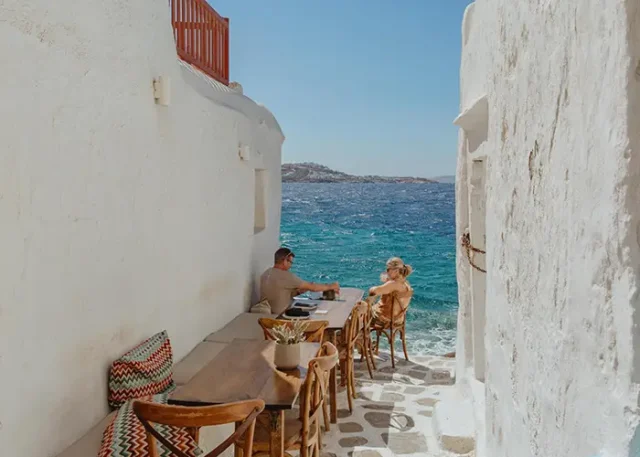
Mykonos Town, known locally as Chora, is a well-preserved example of Cycladic architecture, its whitewashed buildings and blue-shuttered windows forming a dense, maze-like grid designed in part to confuse pirates. Little Venice, the row of houses built directly on the water’s edge, is the town’s most characterful corner and worth finding early before the narrow lanes become congested.
Evening
The working waterfront, lined with fishing boats and the town’s famous pelicans, comes alive in the evening. The area around Taxi Square has a good selection of restaurants serving fresh fish and traditional Greek dishes.
Day 7: Mykonos – Windmills, beaches, and open water
Morning
The Windmills of Kato Mili, standing above Little Venice on the Chora’s western ridge, are among the most recognizable landmarks in the Cyclades. Built in the 16th century to mill grain, they now overlook a very different scene but remain a striking presence.
Afternoon
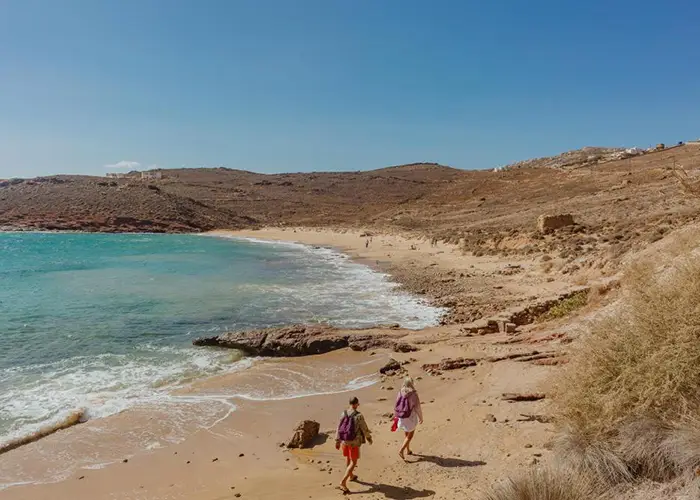
Mykonos has a reputation for nightlife, but its beaches are equally worth the attention. Psarou is a sheltered bay with calm water, while Elia, further down the coast, offers a longer stretch of sand with more of a local feel. Water taxis connect the town to most beaches.
Evening
A late-afternoon boat trip to Delos – the uninhabited island a short distance from Mykonos – offers one of the most atmospheric archaeological experiences in Greece. The birthplace of Apollo and Artemis in Greek mythology, Delos was one of the most important religious centers of the ancient Mediterranean. The site is vast and largely uncrowded.
Day 8: Mykonos to Crete – Heraklion and Knossos Palace
Travel leader Booking.com’s 2026 sustainable travel report found that 43% of travelers plan to avoid crowds, 42% plan to travel out of season, and 25% plan to visit cooler destinations, this year. Crete is a perfect choice for these types of travelers to visit in mid-to-late September or October for cooler temperatures and fewer tourists.
Morning
A morning flight from Mykonos to Heraklion takes around an hour and a quarter, though connecting through Athens is more likely. Rustic Stone Maisonette Krasi holiday home with a terrace, balcony, and garden view, combines traditional decor, accessibility to the deep-rooted mountain trails, and warm welcoming local-style living.
Once you’re settled, The Heraklion Archaeological Museum houses the world’s finest collection of Minoan art, including the famous bull-leaping fresco and the Phaistos Disc, an undeciphered inscription that continues to puzzle scholars.
Afternoon
Knossos, a few miles south of the city, is the largest Bronze Age archaeological site on Crete. The partially reconstructed palace complex, with its multi-story architecture and elaborately frescoed walls, gives a tangible sense of a civilization that flourished more than 3,500 years ago. Allow two to three hours to explore properly.
Evening
Heraklion’s old city comes into its own after dark. The area around the Morosini Fountain – a 17th-century Venetian landmark – is lined with restaurants and bars, with the market street of 1866 nearby for a more local feel.
Day 9: Crete – Chania and the Venetian harbor
Morning
A bus or rental car from Heraklion reaches Chania, on Crete’s northwest coast, in around two hours. Chania’s Old Town is one of the best-preserved in the Mediterranean, its Venetian harbor ringed by former warehouses and topped by a lighthouse that has stood since the 16th century. The covered market at the center of town built in the shape of a cross is still a working food market and one of the most atmospheric spots on the island.
Afternoon
The historic Leather Lane (Skridlof) in Chania’s Old Town is known for its leather workshops and handmade sandals. The Byzantine and Post-Byzantine Collection, in the former church of San Salvatore, covers the island’s layered history.
Evening
The harbor at Chania remains timelessly picturesque. An evening meal along the waterfront with the lighthouse visible across the water is a quietly memorable way to end this stretch of the itinerary.
Day 10: Crete – Elafonissi Beach and departure
Morning
Elafonissi, on Crete’s southwestern tip, is one of the most striking beaches in Greece: A shallow lagoon of warm water separated from the open sea by a narrow sandbar, its sand tinged pink by crushed shells. The drive from Chania takes around an hour and a half when traffic isn’t bad, so an early start allows for a few hours at the beach before heading back for a late flight.
Afternoon
For travelers with enough energy (or an extra day), the Samaria Gorge – a 10-mile hike through one of Europe’s longest gorges, descending from the White Mountains to the Libyan Sea – is an extraordinary alternative for those with the energy for it. If you want to do the full hike, be sure to start earlier than 1:00 pm, though shorter hikes are possible in the afternoon.
Evening
Heraklion’s airport connects to Athens and onward international destinations, and a final evening meal in the city rounds off ten days in Greece on a suitably relaxed note.
Top tips for your stay in Greece
A few practical insights can help you make the most of your Greece itinerary. Here are some essentials worth knowing before your trip:
- Ferry and flight connections between islands can book up quickly in peak season – booking island-hopping transfers several weeks in advance is strongly recommended, especially for routes between Santorini and Mykonos.
- The Greek mesimeri (siesta) is real – many stores, especially in smaller towns and islands, close between 2:00 pm and 5:00 pm. Planning any essential errands for the morning or evening avoids frustration.
- Tipping isn’t obligatory in Greece but is appreciated – rounding up a bill or leaving a small amount for good service is standard practice in restaurants and tavernas.
Research commissioned by Booking.com and independently conducted among a sample of 32,500 respondents across 35 countries and territories (1,000 from USA, 1,000 from Canada, 1,000 from Mexico, 1,000 from Colombia, 1,000 from Brazil, 1,000 from Argentina, 1,000 from Australia, 500 from New Zealand, 1,000 from India, 1,000 from China, 1,000 from Hong Kong, 1,000 from Thailand, 1,000 from Singapore, 1,000 from Taiwan, 1,000 from Vietnam, 1,000 from Indonesia, 1,000 from Philippines, 1,000 from South Korea, 1,000 from Japan, 1,000 from Spain, 1,000 from Italy, 1,000 from France, 500 from Switzerland, 1,000 from the UK, 1,000 from Ireland, 1,000 from Germany, 1,000 from the Netherlands, 1,000 from Belgium, 1,000 from Denmark, 1,000 from Sweden, 1,000 from Croatia, 500 from Greece, 500 from UAE, 1,000 from South Africa and 500 from Kenya). To participate, respondents had to be 18+ years, have traveled at least once in the past 12 months, must be planning to travel in 2026, and be either the primary decision maker or involved in the decision making of their travel. The survey was taken online and took place in January 2026. The age ranges for each generation were defined as: Gen Z 18-28, Millennials 29-44, Gen X 45-60, and Boomers 61+.