
Seasoned travelers develop an instinct for what belongs in their kit. The items that earn a permanent spot aren’t necessarily the most expensive or technologically advanced—they’re the ones that prove useful across contexts, from sketching architectural details in Barcelona to mapping hiking routes in Patagonia.
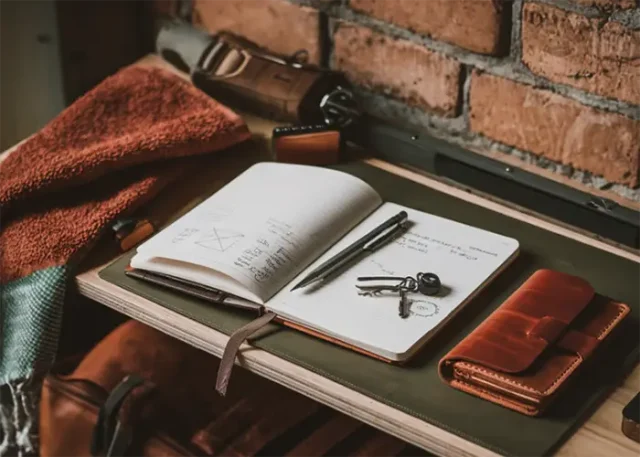
The mechanical pencil has quietly secured this status for a particular type of traveler: those who document their journeys through writing and drawing. Unlike disposable pens that leak at altitude or wooden pencils that require sharpening, a quality mechanical pencil delivers consistent performance in a compact form. For anyone maintaining a travel journal, this reliability matters.
From Patent Offices to Passport Holders
The mechanical pencil emerged in the early 19th century as a solution to a practical problem: how to write without the interruption of constant sharpening. Early designs were crude, but the concept proved sound enough that engineers and draftsmen adopted them for technical work requiring precision.
What began as a tool for architects and engineers gradually found broader application. The fundamental advantage—a writing instrument that maintains a consistent point—appealed to anyone who valued uninterrupted workflow. Modern iterations have refined the mechanism while preserving this core benefit, making them particularly well-suited for travelers who need reliable tools in unpredictable environments.
Why Mechanical Pencils Work for Travel Documentation
The advantages of mechanical pencils for travel journaling extend beyond mere convenience. Consider the practical realities of documenting a journey:
- No sharpening required: Refillable lead eliminates the need to carry a sharpener or search for one in unfamiliar cities. The lead advances with a simple click, maintaining a consistent point throughout use.
- Uniform line quality: Unlike wooden pencils that produce varying line widths as they dull, mechanical pencils deliver consistent marks. This matters when sketching landmarks or writing detailed observations where clarity is essential.
- Designed for extended use: Quality mechanical pencils feature ergonomic grips that reduce hand fatigue during long writing sessions—whether you’re journaling on a train through the Alps or documenting field notes during a research trip.
- Durability in transit: Metal-bodied mechanical pencils withstand the compression and jostling of packed bags better than wooden pencils, which can break, or pens, which can leak.
What Distinguishes a Travel-Worthy Mechanical Pencil
Not all mechanical pencils suit the demands of travel. The best options share several characteristics that become apparent only after extended use in varied conditions:
- Build quality: Look for metal construction rather than plastic. Aluminum or brass bodies survive drops onto cobblestone streets and the constant pressure of being packed and unpacked. The mechanism should operate smoothly even after months of use.
- Pocket-friendly dimensions: A pencil that fits comfortably in a shirt pocket or small notebook sleeve is more likely to be accessible when inspiration strikes. Length matters less than diameter—slim profiles slip easily into tight spaces.
- Reliable mechanism: The lead advancement system should work consistently without jamming. Spring-loaded mechanisms tend to outlast twist-advance designs, particularly in dusty or humid environments.
- Standard lead size: Pencils using common 0.5mm or 0.7mm lead are easier to resupply anywhere in the world. Proprietary sizes create dependency on specific retailers.
These features separate tools that merely function from those that become trusted companions across multiple journeys.
Design Meets Function
The intersection of aesthetics and utility has produced mechanical pencils that appeal to travelers who appreciate thoughtful design. Japanese manufacturers like Pentel have elevated the category with models that balance visual restraint with mechanical sophistication.
Some travelers gravitate toward minimalist designs in brushed metal finishes. Others prefer pencils with knurled grips that provide tactile feedback. The variety reflects different priorities: a photographer might choose a pencil with a built-in eraser for quick sketch corrections, while a writer might prioritize a longer barrel that holds more lead.
What unites these preferences is an appreciation for objects that perform their function well while occupying minimal space—a philosophy that extends to other carefully chosen travel gear.
The Manufacturing Process
Understanding how mechanical pencils are constructed reveals why quality varies so dramatically across price points. The process involves several critical stages:
- Material selection and machining: Premium pencils begin with solid metal stock—typically aluminum or brass—that’s machined to precise tolerances. The barrel must be perfectly cylindrical to house the internal mechanism without binding.
- Mechanism assembly: The lead advancement system consists of multiple small components: a clutch that grips the lead, a spring that provides tension, and a button or twist mechanism that controls advancement. Each part must be manufactured to exacting specifications.
- Surface treatment: Anodizing or powder coating protects metal bodies from corrosion and wear. This step determines both appearance and longevity, particularly for pencils exposed to varied climates.
- Quality control: Reputable manufacturers test each pencil’s mechanism through thousands of cycles to ensure consistent performance. This testing separates reliable tools from those that fail after minimal use.
The attention to these details explains why a well-made mechanical pencil can function reliably for years, even decades, with minimal maintenance.
Precision Tools for Detailed Work
Travelers who sketch architectural details or technical diagrams often prefer drafting-grade mechanical pencils. These instruments, originally designed for engineering work, offer advantages for anyone documenting visual information:
- Fine lead options: Drafting pencils accommodate leads as thin as 0.3mm, enabling precise linework for intricate sketches. This precision proves valuable when capturing the ornate details of Gothic cathedrals or the geometric patterns of Islamic tilework.
- Lead hardness variety: Different lead grades (HB, 2B, 4H, etc.) produce varying line darkness and texture. Carrying multiple lead grades in a single pencil body allows for tonal variation in sketches without carrying multiple tools.
- Fixed sleeve designs: Many drafting pencils feature a fixed metal sleeve that protects the lead and enables use with rulers and templates. This design supports technical drawing in field conditions.
While not every traveler needs this level of precision, those who do find that drafting pencils serve dual purposes: technical documentation and artistic expression.
Maximizing Your Pencil’s Utility
A mechanical pencil’s value depends partly on how you maintain and use it. Several practices extend its lifespan and reliability:
- Carry spare leads: A small lead case takes up negligible space but prevents the frustration of running out mid-journey. Store leads in their original container to prevent breakage.
- Clean the mechanism periodically: Dust and graphite particles accumulate inside the barrel over time, potentially causing jams. Disassemble the pencil every few months and clear debris with compressed air or a soft brush.
- Match lead to paper: Softer leads (B grades) work better on textured paper common in handmade travel journals, while harder leads (H grades) suit smooth paper. Matching lead to surface reduces breakage and improves writing quality.
- Protect the tip: Even durable pencils benefit from a cap or sleeve that protects the lead and mechanism when packed. Many quality pencils include these accessories.
These habits transform a mechanical pencil from a disposable tool into a long-term investment that improves with familiarity.
Choosing Your Travel Companion
The mechanical pencil market offers options across a wide price spectrum, from utilitarian models under $10 to precision instruments exceeding $100. For travelers seeking a balance of quality and practicality, the middle range often provides the best value.
Models like the Grafton mechanical pencil from Everyman exemplify this category with machined metal construction, dependable mechanisms, and designs that develop character over time. These pencils occupy a practical middle ground between disposable office supplies and high-end collectible writing instruments. Comparable brands such as Tactile Turn and Machine Era also produce durable, precision-crafted writing tools aimed at everyday carry enthusiasts and professionals alike.
The choice ultimately depends on how you travel and what you document. A photographer making quick compositional sketches has different needs than a researcher taking detailed field notes. The best mechanical pencil is the one that matches your specific use case while meeting the fundamental requirements of durability, reliability, and portability.
For travelers who value tools that enhance rather than complicate their journeys, a quality mechanical pencil earns its place in the kit—ready to capture observations, sketch scenes, and document the details that make each journey memorable.