

For years, booking flights has followed the same pattern. Travelers choose a destination first, then search for flights and hope the price fits their budget.
But a growing number of travelers are doing the opposite.
Instead of asking, “How much does a flight to Paris cost?”, they start by asking, “Where can I go for €120?”
This simple shift in thinking is changing the way people discover destinations and often helps them find better travel opportunities they might never have considered otherwise.
The Problem With Traditional Flight Search
Most flight search engines are designed around a destination. You enter where you want to go, choose dates, and compare prices.
The problem is that many travelers are flexible.
Maybe you simply want a weekend getaway. Maybe you have a limited budget. Maybe you want warm weather, a beach, or a city break but don’t care exactly where.
Traditional search tools don’t always make these possibilities easy to explore.
As a result, many travelers end up visiting the same destinations repeatedly while overlooking affordable and exciting alternatives.
Budget-First Travel Is Growing
The rise of remote work, digital nomad lifestyles, and frequent short trips has created a new type of traveler.
These travelers often prioritize:
- Affordable flights
- Flexible destinations
- Spontaneous travel
- Maximizing experiences within a fixed budget
Rather than spending hours comparing dozens of routes individually, they want a quick way to see every option available.
This is especially useful in Europe, where low-cost airlines frequently offer surprisingly cheap routes between major cities.
A traveler departing from London, Amsterdam, Milan, or Berlin can often discover dozens of destinations available for less than the cost of a night out.
Why Maps Make Flight Discovery Easier
Humans naturally understand information visually.
Looking at a map often reveals opportunities that would never appear in a traditional search list.
You might discover:
- A direct flight to a city you’ve never considered
- A nearby beach destination within your budget
- A weekend city break with unusually low fares
- Seasonal deals that are easy to miss
When destinations are displayed geographically, travelers can compare options much faster and make decisions based on both price and location.
A Better Way to Discover Destinations
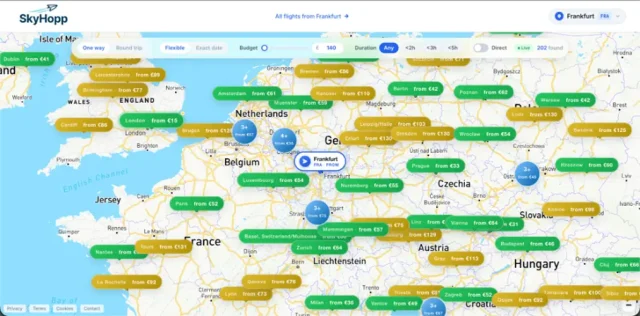
Consider a traveler departing from Frankfurt with a budget of €120.
Instead of manually checking dozens of routes, they might instantly discover Porto, Kraków, and Sofia on the same map — three very different destinations that rarely appear side by side in a traditional flight search.
This approach shifts the focus from searching for a specific destination to discovering possibilities.
For travelers who value flexibility, that difference can unlock entirely new trips.
The Rise of Travel Discovery Tools
In recent years, several travel platforms have focused on helping travelers discover destinations rather than simply booking flights.
These tools are becoming increasingly popular because they encourage exploration.
Tools like SkyHopp take this concept further by displaying destinations on an interactive map and allowing travelers to explore opportunities based on budget rather than destination alone.
Instead of searching route by route, travelers can instantly see where their money can take them and compare destinations visually.
This approach is particularly useful for:
- Weekend travelers
- Budget-conscious travelers
- Digital nomads
- Frequent flyers
- Travelers looking for inspiration
The concept is simple but powerful: let price guide discovery rather than limiting yourself to destinations you already know.
Hidden Gems Often Start With Flexible Search
Some of the best travel experiences happen in places that were never part of the original plan.
A traveler searching for flights to Barcelona might discover Valencia. Exploring flights from Frankfurt with a flexible budget can reveal dozens of unexpected destinations across Europe that might never have been considered otherwise.
Someone planning a trip to Greece might find affordable flights to Albania or Montenegro.
A budget search can uncover destinations that offer similar experiences at a fraction of the cost.
This doesn’t just save money.
It often leads to more authentic travel experiences away from crowded tourist hotspots.
The Future of Flight Planning
Travel planning continues to evolve.
Travelers today expect speed, flexibility, and inspiration from the tools they use.
Rather than forcing users to search one route at a time, modern travel discovery platforms are helping travelers explore possibilities first and decide on destinations later.
As airfare prices fluctuate more frequently and travelers become increasingly budget-conscious, destination discovery is likely to become an even bigger part of trip planning.
For many travelers, the question is no longer:
“How much does it cost to fly there?”
Instead, it’s:
“Where can I go for my budget?”
And that simple question is changing the way people travel.