Restaurant technology is becoming part of everyday service
American restaurants operate in an environment shaped by rising costs, staffing pressure, changing customer expectations and intense competition for attention. Guests increasingly expect to find a menu before they arrive, browse it easily on a phone and place an order without unnecessary friction. For owners, the challenge is adding convenience without making service feel impersonal or creating another complicated system for staff to manage.
That is one reason more U.S. restaurant operators are turning to MenuForma. The platform combines a digital menu, QR access and online ordering in a format that works for independent restaurants, diners, cafes, bars, bakeries, fast-casual concepts, food trucks, hotels and multi-location businesses. Customers scan a code with their phone camera and open the menu in a browser, with no app download required.
From an existing menu to a live QR menu
Restaurant owners do not need to rebuild their menu from the ground up. MenuForma can start with a PDF, a photograph or an existing website link. Its AI-assisted menu scanner can extract items, prices and descriptions, reducing the amount of manual data entry needed to create the first digital version.
Once published, the menu can be updated from a phone or computer. Operators can change prices, add seasonal dishes, upload food photographs, revise descriptions and mark sold-out items as unavailable. Updates appear immediately, so a restaurant does not have to reprint menus whenever ingredient costs change, a promotion ends or an item sells out during service.
QR codes can be customized with the restaurant’s logo, colors and call-to-action. The same menu link can also be shared through Google Business Profile, Instagram, Facebook, TikTok, WhatsApp, email or the restaurant’s own website, giving customers one consistent place to see current offerings.
Ordering modes for different American restaurant formats
The U.S. restaurant market includes everything from full-service dining rooms and neighborhood diners to fast-casual counters, coffee shops and mobile food businesses. MenuForma supports several ordering modes so the technology can match the venue rather than forcing every operator into the same workflow.
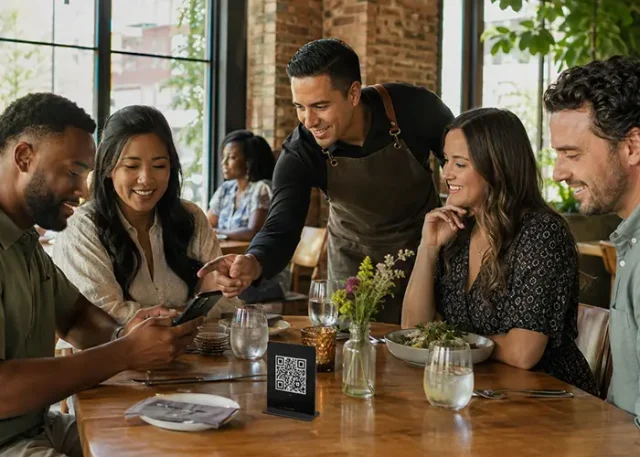
Full-service restaurants can create a separate QR code for each table. Orders are automatically tagged with the table number, helping servers and kitchen staff understand where the order belongs. Cafes, food halls and counter-service concepts can use one unified QR code and assign an order number to each customer.
In self-selection mode, guests choose items on their phone and show the selection to a server, who confirms the order in person. Display-only mode is available when a restaurant wants customers to browse without submitting an order, while tablet mode supports a shared in-store device. These choices let owners add digital convenience while keeping the level of human interaction that fits their concept.
Direct takeout and delivery ordering
Takeout and delivery have become permanent revenue channels for many American restaurants. MenuForma allows a business to accept pickup, takeout and delivery orders through its own digital menu. Customers can browse the restaurant’s current items, choose options and provide the contact or delivery information needed to fulfill the order.
This gives independent operators a direct ordering channel instead of requiring every customer to go through a third-party marketplace. MenuForma does not take a commission from orders placed through the restaurant’s MenuForma menu. The restaurant remains in control of its menu, pricing, availability and customer experience, which can be particularly important for businesses working with narrow margins.
Multilingual menus for diverse communities and international guests
The United States is a multilingual market, and restaurants regularly serve local communities, business travelers and tourists who may prefer different languages. MenuForma can translate menus into more than 70 languages, helping guests understand ingredients, preparation methods and available choices without requiring staff to translate every item during a busy shift.
Restaurants can also display allergen information alongside dishes. Requirements vary by jurisdiction and restaurants remain responsible for verifying ingredients, translations and disclosures, but a digital format makes important information easier to update and present consistently than maintaining several printed versions.
Payments, order alerts and daily operations
Where supported, restaurants can connect online payments through their own payment account. Customers can use available card or digital-wallet methods, while payment details are processed by the payment provider rather than stored by MenuForma. Available payment methods depend on the restaurant’s provider and account configuration.
New orders can generate real-time alerts on desktop, tablet and mobile devices. Receipt and thermal-printer support can bring digital orders into a workflow that staff already understand. Team accounts allow different employees to access the tools they need, while multi-location management helps operators oversee several restaurants and menus from one account.
Analytics provide visibility into menu views, popular items, customer behavior and sales performance. MenuForma also includes a tool for encouraging Google reviews after an order, connecting the dining experience with the online reputation that often influences where American customers choose to eat.
Useful for hotels, food trucks, bars and growing restaurant groups
MenuForma is designed for more than a traditional dining room. Hotels can create a different QR code for each room, allowing guests to order room service immediately or schedule a preferred delivery time. Food trucks can update availability as items sell out, bars can organize drink categories and seasonal specials, and bakeries can use a unified code for quick counter ordering.
For restaurant groups, the ability to manage multiple locations from one account reduces duplicated work. Each venue can maintain its own items, prices and service style while the business uses a consistent digital structure across the organization.
Why more U.S. restaurants are choosing MenuForma
The appeal of MenuForma is not based on one feature alone. It brings together tools that restaurants might otherwise have to manage separately: a free QR menu, online ordering, table-specific codes, takeout and delivery, multilingual content, payments, printing, analytics, team access and multi-location management.
A small independent restaurant can begin with the essential tools for a QR menu and online ordering, then add more advanced capabilities as its needs grow. MenuForma offers a free plan and paid options for businesses that require additional languages, delivery, payments, analytics, team accounts or multiple locations.
Most importantly, the customer still sees the restaurant rather than the software. Diners see current dishes, prices, photographs and ordering options; staff gain a more organized way to manage changes and incoming orders. The food, brand and hospitality remain at the center of the experience.
A practical way to modernize restaurant service
For a U.S. restaurant considering its first digital menu, getting started can be straightforward: upload the existing menu, review the extracted information, add photographs and allergen details, choose the appropriate QR mode and place the code on tables or printed materials. The menu link can then be added to online profiles so customers can browse before they visit.
As more American restaurants look for technology that saves time without weakening hospitality, MenuForma offers a practical middle ground. It helps businesses modernize menus and ordering while preserving the flexibility, personality and direct customer relationships that make independent restaurants valuable to their communities.