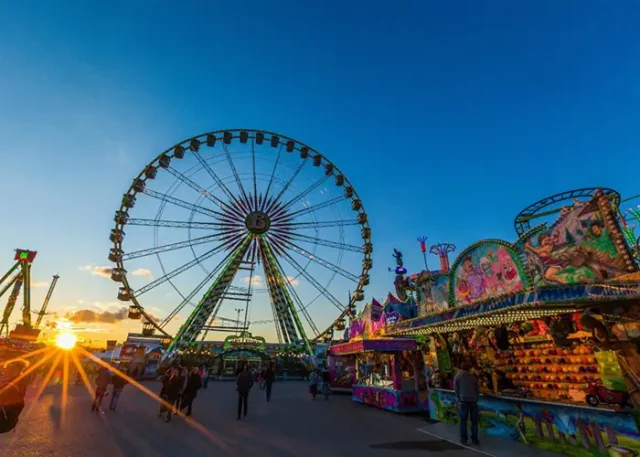
Germany’s fall festival season extends well beyond Oktoberfest. From September through early November, cities and wine regions across the country celebrate the harvest, local food, literature, music and traditions that have survived for centuries.
Some events fill enormous fairgrounds with beer tents and amusement rides. Others transform historic centers with market stalls, concerts or illuminated landmarks. Together, they offer travelers an opportunity to experience regional German culture at one of the most atmospheric times of year.
Here are eight festivals worth building into a trip to Germany in fall 2026.
Oktoberfest, Munich
September 19–October 4, 2026
The world’s most famous beer festival returns to Munich’s Theresienwiese for its 191st edition. Although beer is central to the experience, Oktoberfest is also an enormous celebration of Bavarian culture, food, music and family traditions.
The festival officially begins when Munich’s mayor taps the first keg and announces “O’zapft is!” From there, 16 days of celebrations unfold across vast beer tents operated by Munich breweries.
Inside the tents, visitors share long tables while brass bands perform traditional Bavarian music alongside more contemporary festival favorites. Food choices range from roast chicken and sausages to giant pretzels, dumplings, grilled fish and sweet pastries.
The festival grounds also contain roller coasters, carnival games, historic rides and family-friendly attractions. Major parades bring traditional costumes, decorated horse-drawn brewery wagons and marching bands into the streets.
Admission to the grounds is generally open, but tables inside the most popular tents can be difficult to secure during evenings and weekends. Travelers who do not have reservations may have better luck arriving early on a weekday.
Public transportation is the easiest way to reach the grounds, as parking is extremely limited. The official Oktoberfest website provides current information about opening hours, tent policies and special events.
Cannstatter Volksfest, Stuttgart
September 25–October 11, 2026
Travelers looking for a major folk festival beyond Munich can head to Stuttgart for the Cannstatter Volksfest. Held on the Cannstatter Wasen beside the Neckar River, it is one of Germany’s largest public celebrations.
The festival began in 1818 as an agricultural and harvest celebration following years of food shortages. Its historic centerpiece is the Fruit Column, a decorated wooden monument topped with a bowl of fruit that remains a symbol of the event’s agricultural origins.
Modern celebrations include large festival tents, regional food, live music, carnival rides and hundreds of vendors. Stuttgart breweries serve local beer, while menus feature Swabian specialties such as Maultaschen, Spätzle and roasted meats.
The 2026 edition coincides with the Landwirtschaftliches Hauptfest, a large agricultural exhibition held every four years. This adds livestock displays, farming demonstrations and exhibits examining food production and rural life in southern Germany.
The festival is easily reached by public transportation from central Stuttgart. Weekend evenings can become exceptionally busy, so daytime and weekday visits offer a more relaxed experience. Dates and visitor information are available from the City of Stuttgart.
German Grape Harvest Festival, Neustadt an der Weinstraße
September 25–October 12, 2026
Germany’s wine regions take on a different rhythm during the fall harvest. Vineyards turn shades of gold and red, wineries bring in their grapes and towns throughout the country host festivals celebrating the new vintage.
One of the season’s most important gatherings is the German Grape Harvest Festival in Neustadt an der Weinstraße. Located in the Palatinate wine region, Neustadt is surrounded by vineyards and sits along the German Wine Route.
The festival includes a historic wine village where visitors can sample wines from local producers, accompanied by Palatinate dishes and live music. The program traditionally includes the selection of the German Wine Queen, a role that involves representing the country’s 13 wine regions and promoting German wine internationally.
Another highlight is the annual grape harvest parade, when floats, marching groups, musicians and wine representatives travel through the town.
Neustadt can be reached by train from cities including Mannheim, Heidelberg and Frankfurt. Travelers with additional time can explore nearby wine villages or follow part of the German Wine Route through the surrounding countryside.
The wider festival season runs from late September into October, although individual events and the main wine village may operate on more limited dates. Visitors should consult the current program before traveling.
Frankfurt Book Fair
October 7–11, 2026
Germany’s fall calendar is not limited to harvests and folk traditions. The Frankfurt Book Fair brings authors, publishers, agents, illustrators, translators and readers from around the world to Frankfurt each October.
The event is one of the international publishing industry’s most important meeting places. During the first part of the fair, much of the activity focuses on professional discussions, publishing rights and industry presentations. The event then opens more widely to the public, with author appearances, readings, talks and book signings.
Programming also extends beyond the exhibition grounds. Cultural institutions, bookstores and venues across Frankfurt host readings, performances and discussions during the fair.
General public access begins on Friday, October 9, in 2026 and continues through the weekend. Travelers interested in particular writers or events should consult the schedule and reserve where required.
Frankfurt’s location and major international airport make the book fair easy to combine with visits to the Rhine or the nearby Rheingau wine region.
New Fall Festival, Düsseldorf
October 7–11, 2026
Düsseldorf’s New Fall Festival presents contemporary music in venues more commonly associated with theater, classical performance, art and architecture.
Instead of relying on a single arena or outdoor festival ground, concerts are staged across distinctive cultural spaces including the Düsseldorfer Schauspielhaus, Deutsche Oper am Rhein, Johanneskirche and several halls within the Kunstpalast complex.
The 2026 lineup includes artists such as Apparat, The Cinematic Orchestra, Glen Hansard, Greentea Peng, José González, Babyshambles, Skinshape and the German-Swiss duo BOY performing with the Kaiser Quartett.
This combination of music and architecture distinguishes the festival from a conventional concert series. Performances are designed to encourage audiences to experience both the artists and the settings in which they appear.
Concerts are ticketed individually, and some venues have relatively limited capacities. Travelers should check the official New Fall Festival program and reserve preferred performances in advance.
Berlin Festival of Lights
October 9–18, 2026
For ten evenings in October, Berlin becomes an open-air gallery during the Festival of Lights.
Artists use projection mapping, video and large-scale light installations to reinterpret landmarks, public squares and historic buildings across the capital. The 2026 theme, “Colours of Love,” explores different expressions of love through light, art and music.
The program changes from year to year, but installations commonly appear around prominent areas such as Brandenburg Gate, Bebelplatz, Potsdamer Platz and Museum Island. Many outdoor displays can be viewed without admission, allowing visitors to create their own nighttime walking route through the city.
The 2026 festival also includes immersive light and music performances at Berlin Cathedral from October 13 to 17.
Because installations are spread across the city, it is best to focus on one neighborhood each evening rather than trying to see everything at once. Public transportation continues to be the most practical way to travel between the larger projection sites.
Visitors should check the official festival map shortly before heading out, as participating locations, projection times and temporary changes can vary.
Weimar Onion Market
October 9–11, 2026
The onion may seem like an unlikely reason for a citywide celebration, but Weimar’s Zwiebelmarkt has become one of Thuringia’s largest and oldest festivals.
The tradition dates back more than 370 years. During the festival, Weimar’s historic center fills with hundreds of stalls selling regional produce, crafts and food.
The event’s signature souvenirs are decorative onion braids created by growers from the nearby Heldrungen region. Some are practical, while others are woven with dried flowers and colorful accents.
Visitors can also try onion-based regional foods, including onion tart, soups and savory baked dishes. Music stages and street entertainment add to the atmosphere throughout the center.
The festival takes place among Weimar’s significant cultural landmarks. Travelers can combine the market with visits to the Goethe National Museum, Schiller’s former home, the Bauhaus Museum and other sites associated with the city’s literary and design history.
Accommodation can become scarce during the festival weekend, so advance reservations are advisable.
Freimarkt, Bremen
October 16–November 1, 2026
Bremen describes the Freimarkt as its “fifth season.” Dating to 1035, the nearly 1,000-year-old tradition is among Germany’s longest-running folk festivals.
The main event occupies the Bürgerweide near Bremen’s central train station, where hundreds of operators set up rides, food stands, games and entertainment venues. The festival includes approximately 50 major rides, ranging from traditional carousels and Ferris wheels to high-speed contemporary attractions.
A smaller historic market takes place in the city center, creating a more traditional atmosphere near Bremen’s UNESCO-listed Town Hall and Roland statue. This is a good place to encounter crafts, regional food and entertainment inspired by earlier periods in the festival’s history.
A large parade is another highlight, bringing decorated floats, bands and costumed groups through the city.
The 2026 Bremen Freimarkt runs for 17 days. The Bürgerweide site is within walking distance of the main railway station, making it one of the easiest large German festivals to reach without a car.
Planning a Fall Festival Trip Through Germany
Germany’s rail network makes it possible to combine several festivals, but travelers should avoid trying to cover all eight in a single trip. Munich, Stuttgart and Neustadt work well as a southern itinerary focused on Bavarian and wine traditions. Frankfurt, Weimar, Berlin and Düsseldorf offer a more culture-oriented route, while Bremen can anchor a northern Germany itinerary.
Fall weather can vary considerably. Warm afternoons may give way to cold evenings, particularly in October. Pack layers, a waterproof jacket and comfortable footwear suitable for cobblestones, festival grounds and long periods of walking.
Hotels and intercity trains can fill quickly during major events. Oktoberfest weekends are especially busy, but the Frankfurt Book Fair and Weimar Onion Market also create strong local demand.
Travelers should confirm dates, opening hours, reservation requirements and public transportation notices with organizers shortly before departure. With some advance planning, Germany’s fall festivals offer something far richer than a conventional sightseeing trip: a chance to experience the foods, traditions and creative culture that bring communities together as the seasons change.