Marrakech has long had a soundtrack of its own. From the rhythms and performers of Jemaa el-Fnaa to traditional Gnawa music and the late-night energy of the medina, music is woven into the experience of the Moroccan city.
But another sound is beginning to find an audience.
A small but growing jazz scene is emerging in Marrakech, with local musicians blending Moroccan traditions with jazz, blues and gospel while restaurants and intimate venues provide more opportunities to hear live music.
For travelers, it adds another dimension to a city already celebrated for its souks, food, architecture, rooftop terraces and nightlife.
A Different Side of Marrakech After Dark
Despite Marrakech’s international reputation as a cultural destination, jazz has historically occupied a relatively small corner of its music scene.
Visitors looking for an evening out have traditionally found plenty of Moroccan folklore and traditional entertainment at one end of the spectrum and DJs, clubs and contemporary nightlife at the other. Dedicated spaces for jazz and other forms of live music have been less common.
That appears to be changing.
Audiences are growing, musicians are passing through the city and hospitality venues are increasingly incorporating live performances into their evening programs.
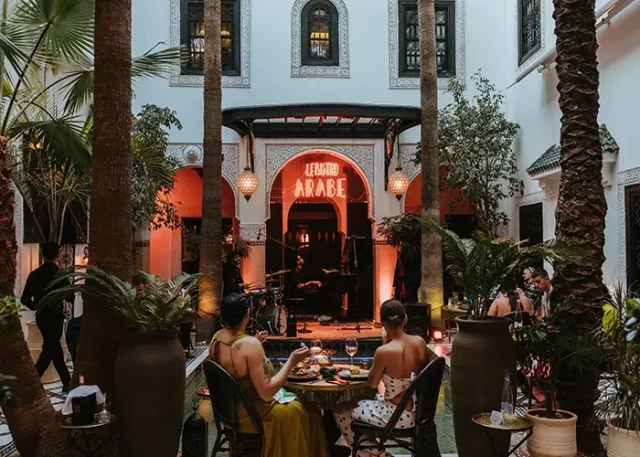
One of the places helping develop that audience is Le Bistro Arabe, an intimate restaurant in the Marrakech medina that regularly hosts live jazz.
Where Gnawa Meets American Jazz
Central to the venue’s music program is Black Experience, a Marrakech-based five-piece formed around 2022.
The self-taught group brings together musicians from Morocco and Ivory Coast, combining traditional Moroccan Gnawa music with American jazz, gospel, blues and ragtime.
Rather than simply performing jazz standards, the musicians reinterpret familiar songs through Gnawa rhythms and their own musical influences, creating a sound that reflects both Morocco and the wider African roots of jazz.
That connection is particularly interesting for culturally curious travelers.
Gnawa music has deep roots in sub-Saharan African traditions and incorporates hypnotic rhythms, call-and-response vocals and distinctive instrumentation. Jazz evolved an ocean away, but its African musical heritage creates common ground between the two traditions.
When those sounds meet in contemporary Marrakech, the result feels less like a musical experiment and more like a conversation between traditions that share distant roots.
Live Jazz in the Medina
Black Experience has developed a following through regular performances at Le Bistro Arabe, part of the Riad Monceau Collection near Jemaa el-Fnaa.
The setting itself is far removed from the atmosphere of a large concert venue. Guests dine in an intimate courtyard surrounded by palms and traditional Moroccan architectural details while musicians perform nearby.
For travelers, that scale can be part of the appeal. Rather than attending a formal concert, live music becomes part of an evening in the medina—dinner, drinks and jazz unfolding within the surroundings of a traditional riad.
The Riad Monceau Collection also includes La Pergola, a rooftop restaurant and bar where live Gnawa jazz forms part of the experience, along with Riad Monceau and Caravan cocktail bar.
Could Marrakech Become a Jazz Destination?
Whether Marrakech eventually develops a jazz reputation comparable with more established music destinations remains to be seen, but several ingredients are already in place.
The city attracts an international audience, has a strong hospitality and nightlife scene and possesses a deep musical heritage of its own. Most importantly, there are musicians interested in exploring the space between Moroccan traditions and international musical styles.
What the scene needs is more places for those musicians to perform.
As additional restaurants, hotels and cultural venues embrace live music, jazz could become another reason for visitors to explore Marrakech after sunset—and another way to experience the creative energy that has long attracted artists, designers, musicians and travelers to the city.
Marrakech Beyond the Souks
For many first-time visitors, Marrakech revolves around familiar experiences: wandering the souks, exploring palaces and gardens, eating on rooftop terraces and watching Jemaa el-Fnaa transform as evening arrives.
Its emerging jazz scene doesn’t replace any of those experiences. Instead, it offers another layer.
An evening listening to Moroccan musicians weave Gnawa rhythms into jazz and blues can reveal a more contemporary side of Marrakech—one that draws on the city’s traditions without being confined by them.
And that may ultimately be what makes jazz an intriguing addition to Marrakech’s cultural landscape. In a city where African, Arab, Berber and European influences have intersected for generations, musical traditions crossing paths feels entirely at home.