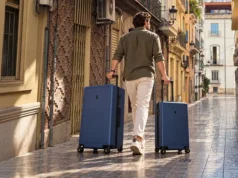

Your smartwatch says you slept for seven hours. Your sleep score looks decent. So why do you feel like you’ve barely slept at all?
You arrived in a new time zone yesterday, spent the night in an unfamiliar hotel room, and woke up feeling more tired than when you went to bed. Your watch has plenty of data, but it can’t tell you whether the problem is jet lag, a restless night, or simply an exhausting day of travel.
It’s a familiar frustration for people who spend a lot of time on planes and in hotels. Technology can tell us more about our sleep and daily habits than ever before, yet all that information doesn’t necessarily make traveling feel easier.
That’s where wearable wellness tools get interesting. Some help you recognize patterns, others guide relaxation, and a growing number offer different ways to build familiar routines away from home. The challenge is figuring out which ones deserve space in your bag.
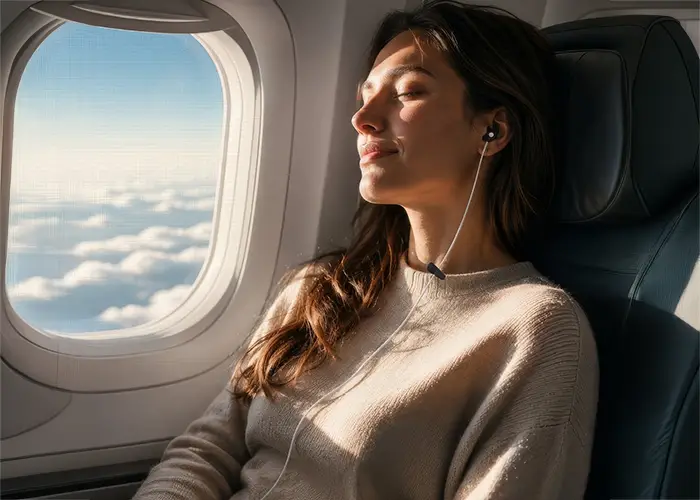
When Your Sleep Tracker Says You’re Fine but You Feel Exhausted
A sleep tracker can be useful on the road, especially when travel makes it difficult to keep a consistent schedule. But the number on your screen isn’t always a good reflection of how rested you feel.
Imagine flying from Los Angeles to New York for a two-day business trip. You manage seven hours in bed, but you wake up at 7 a.m. local time, when your body is still much closer to 4 a.m. Los Angeles time. Your watch may record a reasonable amount of sleep without accounting for how your internal clock affects your alertness.
There’s also the possibility that you were simply exhausted before the flight. An early airport departure, a late dinner, and a night spent answering emails can leave you tired even without crossing time zones.
Consumer wearables estimate sleep from measurements such as movement and heart rate. They’re convenient, but their estimates of individual sleep stages and brief awakenings can differ from clinical sleep measurements. In a 2024 study, Kainec and colleagues compared five commercial sleep-tracking devices with laboratory polysomnography and found device-dependent differences in sleep estimates.
For frequent travelers, the most useful information is often less complicated than a nightly recovery score. Look at how long you actually allowed yourself to sleep, whether you went to bed later than planned, and whether the same travel arrangements keep cutting your nights short.
If your tracker repeatedly shows six-hour nights whenever you take an early flight, it has identified something you can act on. Choosing a later departure when possible may be more useful than buying a newer tracker.
Three Types of Wearable Wellness Tools Worth Knowing
Travel wellness technology becomes easier to evaluate when you consider what each device is supposed to help you do.
Some devices collect information. Others help you follow a particular routine. Tools designed around light exposure or time-zone planning serve another purpose altogether.
| Type of travel wellness tool | What it can help with | What it won’t do |
| Smartwatch or sleep-tracking ring | Spotting changes in sleep duration, activity, and routine | Diagnosing why you feel tired or correcting jet lag |
| Light-management tools and travel planning apps | Planning light exposure and sleep timing across time zones | Guaranteeing an immediate adjustment to local time |
| Guided breathing or biofeedback wearables | Providing structure for a short relaxation activity | Removing the underlying causes of travel stress |
| Ear-worn electrical stimulation devices | Offering a timed stimulation session as part of a wellness routine | Automatically treating jet lag or producing proven sleep benefits |
A smartwatch makes sense for someone who wants to understand how frequently travel disrupts their sleep schedule. A light-planning app may be more relevant to someone flying between continents every month.
Relaxation-oriented wearables address a different situation: the traveler who has finally reached the hotel but still feels wounded from crowded terminals, delays, and meetings.
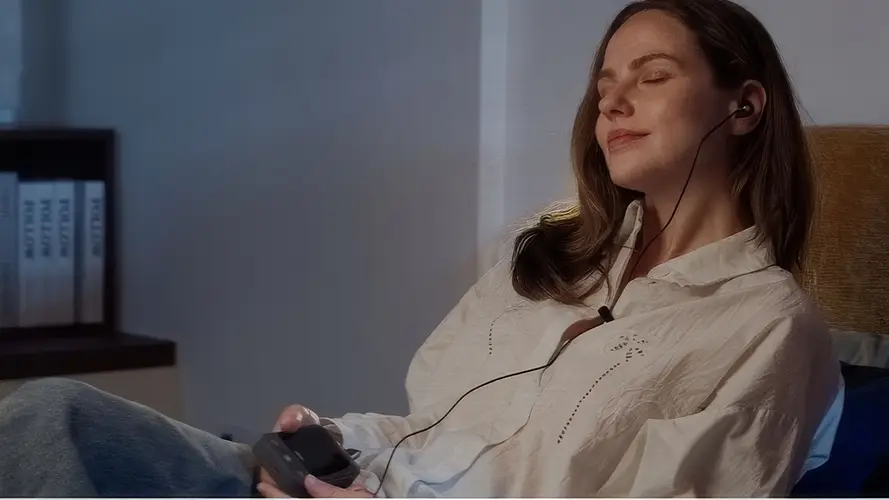
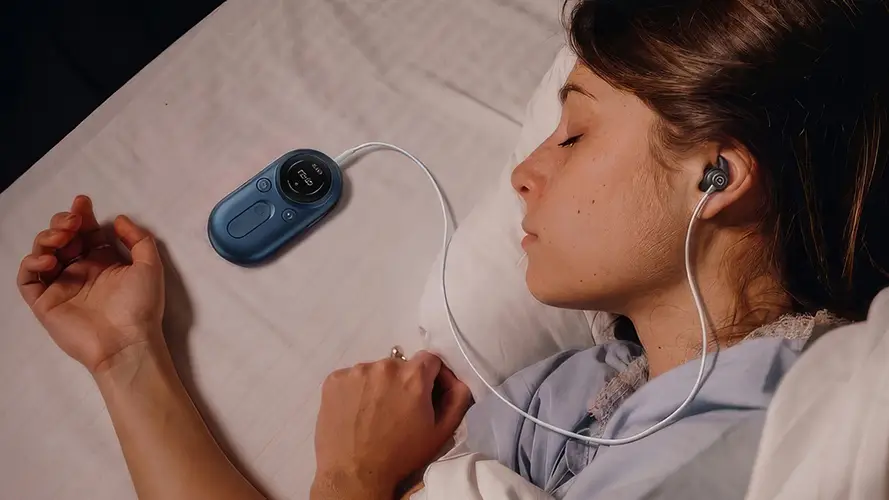
After spending the day checking flight updates and answering messages, you may want a break that doesn’t require staring at another screen. That is one reason travelers may be interested in portable wearable wellness technology, including ZenoWell’s compact, ear-worn vagus nerve stimulation devices.
These devices use transcutaneous auricular vagus nerve stimulation, or taVNS. Small electrical pulses are delivered through electrodes positioned at selected areas of the outer ear associated with vagal sensory pathways. ZenoWell offers timed modes intended for different wellness routines, including relaxation and pre-sleep use.
The appeal is practical: a compact device can be packed for a hotel stay and used during a planned quiet session. But an ear-worn device isn’t a substitute for sleep, and research involving taVNS as a technique doesn’t establish that every consumer device improves sleep or reduces travel-related stress.
The better question is whether that kind of routine suits how you actually travel.
What Makes a Wellness Device Worth Packing?
The product that looks impressive at home may be the first thing you leave behind when you’re rushing to catch a flight.
Picture arriving at your hotel close to midnight. Your suitcase is still half-packed, your phone is almost dead, and you’ve got an early start. Are you really going to open another app, pair a device, and spend ten minutes troubleshooting a connection? Probably not. That’s why portability involves more than size and weight. What matters is how much effort the device requires when you’re tired, distracted, or working with limited space.
Start with setup. Can you begin a session without navigating several screens? Does the device require an internet connection? If you travel internationally, check whether its essential functions remain available without reliable Wi-Fi or mobile data.
Think about comfort. An ear-worn device needs to fit comfortably and maintain appropriate electrode contact. A wrist device worn overnight shouldn’t be so uncomfortable that you keep adjusting it. Test anything new at home before relying on it during a trip.
Check charging requirements. A compact device isn’t particularly convenient if it needs a proprietary charger you regularly forget. Consider battery life, cable requirements, and whether charging fits around the phone and laptop you already carry.
Look beyond the purchase price. Some devices depend on subscriptions for certain features. Others require replacement accessories or additional supplies. Those costs can add up, especially if the device becomes part of a frequent travel routine.
For electrical stimulation products, session requirements and safety instructions are particularly important. Electrode placement, contact, and intensity can affect the experience. Follow the manufacturer’s directions, and don’t assume that stronger stimulation means better results.
A device intended for a timed seated session also shouldn’t be treated as something to wear overnight, while driving, or whenever you happen to be moving through an airport.
The easiest way to test a product’s travel value is to use it at home under travel-like conditions. Give yourself the same amount of time you’d realistically have in a hotel room. If setup feels inconvenient when everything is familiar, it probably won’t feel easier on the road.
How to Use Wellness Technology Before, During, and After a Trip
A useful travel wellness routine begins before you leave home. You don’t have to plan every hour, but knowing what your devices are supposed to help with can prevent you from collecting measurements you never use.
Before departure: Look for patterns, not perfect scores
Review your recent travel sleep history, if you already use a tracker. Do early departures repeatedly shorten your sleep? Do you tend to go to bed much later during conferences? These patterns are more useful for planning than trying to raise a sleep score by a few points.
For a trip across several time zones, use a reliable planning resource to consider your sleep schedule and light exposure. According to the CDC’s Yellow Book 2026, shifting sleep toward the destination schedule before departure may help with adaptation. The direction of travel determines whether you would generally be shifting earlier or later.
Travelers interested in resetting your sleep schedule can also learn why consistent wake times and appropriately timed light exposure matter more for circadian adjustment than a single night’s wearable readings.
If a device is new, learn its controls before you pack. You don’t want your first experience with unfamiliar stimulation settings or electrode placement to happen in a dark hotel room.
During travel: Use the simplest tools first
On a long flight, a sleep mask and earplugs may be more useful than a device that needs repeated attention. If you’re hoping to rest, reduce unnecessary screen use, settle into a comfortable position, and follow airline safety instructions.
For flights crossing multiple time zones, the CDC advises organizing sleep, meals, and light exposure around the destination schedule when practical. Avoid making yourself severely sleep-deprived just to follow a plan.
If you wear a smartwatch, there’s no need to monitor every change in heart rate while navigating the airport. Checking your activity or sleep history later may give you more useful information than watching live metrics during an already demanding day.
At the hotel: Give yourself a repeatable transition
The first fifteen minutes after arriving at a hotel often determine how the evening unfolds. You can keep answering messages, order food while scrolling through your phone, and go straight from travel decisions into tomorrow’s planning.
Or you can make the transition a little more deliberate.
Put your essentials where you’ll find them in the morning. Adjust the room temperature and lighting. Change into comfortable clothes, decide what needs your attention tonight, and put the rest aside.
After that, choose one activity that feels good. It might be stretching, reading, guided breathing, or a timed session with a wellness device you already know how to use.
If you’re using an ear-worn stimulation device, follow its recommended session length and product-specific precautions. People with implanted electronic medical devices or relevant medical conditions should review warnings and seek appropriate professional guidance before considering electrical stimulation.
The purpose is to make a familiar routine easier to repeat away from home, not to create another demanding task at the end of the day.
What Wearables Can Help With—and What They Can’t Fix
The most common mistake in travel wellness is treating different kinds of fatigue as though they have the same solution.
If you’ve flown from San Francisco to London and feel wide awake at midnight, your internal clock may still be running on Pacific time. A wearable that measures sleep or guides relaxation won’t directly solve that mismatch.
Light timing is particularly important for circadian adjustment. The CDC explains that appropriately timed bright light can help shift the body’s internal clock, with different strategies needed for eastward and westward travel. For large time-zone changes, using a personalized jet lag calculator can be safer than relying on a simple rule about morning sunlight.
That is different from feeling tense after a day spent rushing through airports. Relaxation practices may be useful in that situation, regardless of whether you’ve changed time zones.
And both are different from missing several hours of sleep because you took an overnight flight. No wearable can replace the sleep opportunity you lost.
These distinctions also matter when reading claims about newer devices.
Research on taVNS has examined its effects on neural and physiological processes and has explored potential clinical applications. But studies use particular stimulation protocols, participants, and outcome measures. A finding involving brain activity or heart rate variability doesn’t automatically show that a commercial wearable helps travelers sleep better.
Likewise, a study conducted with patients experiencing a diagnosed sleep disorder cannot simply be treated as evidence that healthy travelers will recover faster from long flights.
Consumer sleep trackers have their own limitations. They can provide convenient estimates, but they aren’t diagnostic instruments. If you regularly experience severe sleepiness, persistent insomnia, loud snoring, or other concerning symptoms, a clinical evaluation is more appropriate than collecting additional wearable scores.
Knowing what the technology cannot do makes it easier to appreciate the functions that genuinely fit your needs.
Build a Travel Wellness Kit You’ll Actually Use
A travel wellness kit should reflect your itinerary, not the number of new gadgets on the market.
For a frequent business traveler, a familiar sleep tracker may be enough to reveal that early flights and late meetings keep reducing sleep time. A light-planning app could be useful when international travel is common. If hotel evenings tend to feel hectic, a simple relaxation routine may be worth keeping.
Someone taking a long vacation may have different priorities. Comfortable sleep accessories, an easy-to-use activity tracker, and enough flexibility to rest may be more valuable than carrying several specialized devices.
For short domestic trips, the simplest setup may be the best. If you’re not crossing time zones and generally sleep well away from home, there’s little reason to add technology just because it’s marketed for travelers.
Before packing something new, ask yourself three questions: What specific travel problem am I hoping to address? When will I actually use this device? And what will I do differently with the information or experience it provides?
If you can’t answer those questions, leave it at home for now.
The best travel wellness technology doesn’t need to be the most advanced product in your bag. It needs to earn its place, whether by helping you notice a recurring sleep problem, plan around a difficult time-zone change, or keep a familiar relaxation routine when your surroundings change.
Your next trip will probably still involve early alarms, crowded terminals, and the occasional restless hotel night. A thoughtful collection of tools won’t eliminate those experiences, but it can help you spend less time managing gadgets and more time enjoying the journey.
References
Centers for Disease Control and Prevention. (2025). Jet lag disorder. In CDC Yellow Book 2026: Health information for international travel.
Kainec, K. A., & Spencer, R. M. C. (2024). Evaluating accuracy in five commercial sleep-tracking devices compared to research-grade actigraphy and polysomnography. Sensors, 24(2), 635.