
For travelers, coral reefs offer some of the ocean’s most memorable encounters: schools of fish moving through branching corals, intricate underwater landscapes, and the discovery of a world just beneath the surface. For coastal communities, these ecosystems also help protect shorelines, sustain fisheries, and support tourism livelihoods.
A new global assessment brings the vulnerability of those environments into sharp focus. Released on October 22, 2026, the first global coral reef assessment under the International Union for Conservation of Nature’s Red List of Ecosystems classifies 96% of assessed shallow-water coral reef ecosystems as Critically Endangered, with nearly every assessed ecosystem facing an extremely high risk of collapse by 2075.
The MSC Foundation, the philanthropic arm of the MSC Group, served as the assessment’s principal funder. Its support connects a global scientific effort with ongoing coral research and restoration work at Ocean Cay in The Bahamas.
What the Coral Reef Assessment Reveals
Presented at the United Nations biodiversity conference, COP17, in Yerevan, Armenia, the assessment brought together more than 250 scientists and specialists. It draws on decades of observations and climate data, covering warm, shallow-water reef ecosystems across 127 tropical and subtropical ecoregions in more than 80 countries and territories.
The findings concern the condition and future resilience of entire ecosystems. The 96% figure does not mean that 96% of individual corals have already died, nor that every reef has already collapsed. Instead, the assessment evaluates the risk of ecosystem collapse using historical observations, current conditions, and future climate projections.
It is also distinct from the IUCN’s assessment of individual coral species, which found in 2024 that 44% of assessed reef-building coral species were threatened with extinction.
The message is urgent, but it is not a declaration that recovery is impossible. Reducing pollution, managing fisheries sustainably, and expanding marine protected areas can help strengthen reef resilience. Tackling climate change and further ocean warming remains essential to giving those efforts a lasting chance of success.
Why Healthy Reefs Matter to Travel
Coral reefs are part of the natural infrastructure that makes many coastal destinations possible. They provide habitats for marine life, help protect coastlines from storms and erosion, and support the fishing and tourism economies on which communities depend.
For destinations associated with snorkeling, diving, and time on the water, reef decline has implications well beyond the underwater experience. It threatens livelihoods and the environmental foundations of coastal tourism.
That connection makes the assessment particularly relevant to the travel industry. Protecting marine environments is part of protecting the places people travel to experience—and the communities that welcome them.
Coral Research at Ocean Cay in The Bahamas
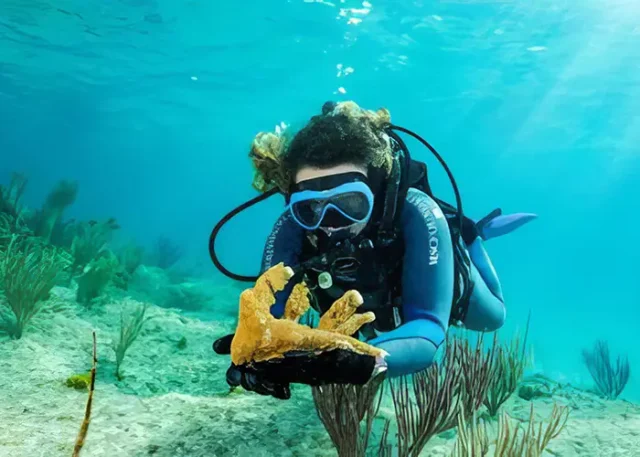
At Ocean Cay, the MSC Foundation’s Super Coral Reefs Program brings together Bahamian and international scientific partners to study heat-tolerant corals, grow corals in underwater nurseries, and evaluate restoration techniques.
The work includes identifying and cultivating Acropora palmata, commonly known as elkhorn coral. This critically endangered species is a fast-growing reef builder whose branching structures provide shelter and nursery habitats for marine life.
The program’s research asks an increasingly important question: how can restoration support reef recovery and resilience as marine heatwaves place corals under greater stress?
DRIFT has previously explored the foundation’s coral conservation roadmap for The Bahamas, providing further background on its scientific collaboration at Ocean Cay.
Connecting Cruise Guests with Marine Conservation
Opened in April 2025, the MSC Foundation’s Marine Conservation Center at Ocean Cay provides facilities for coral research, propagation, and education.
Alongside its scientific work, the center supports opportunities for Bahamian students and researchers to develop marine science expertise. It also introduces cruise guests and other visitors to the importance of reef ecosystems and the challenges involved in protecting them.
For travelers, this offers a deeper perspective on a destination often experienced through its beaches and clear water. The surrounding marine environment becomes a living ecosystem to understand, with research and conservation work extending beyond the duration of a port visit.
A Critical Window for Action
The foundation says its teams are monitoring nursery-grown corals and taking protective measures against heat stress during the latest marine heatwave. Early observations have shown encouraging signs of resilience, although these remain part of ongoing research.
It is also increasing investment in research facilities, specialist expertise, restoration methods, and scientific partnerships.
The global assessment and the work at Ocean Cay operate at different scales, but address the same challenge: understanding what reefs need to survive and translating that knowledge into effective action. For the destinations and communities that depend on healthy seas, the opportunity to act remains open—and increasingly urgent.