Most visitors experience Bali from the bottom of the island. They land in Denpasar, settle into the beach clubs of Canggu or the resorts of Nusa Dua, and never learn that the island has a second life on its eastern shore. There, beneath a string of quiet fishing villages, lies some of the most rewarding underwater terrain in Indonesia. The water is calmer, the reefs begin meters from the sand, and the crowds thin to almost nothing. After fifteen years of running dive operations here, I can say the pattern never changes: the travelers who make the drive east rarely talk about the south again.
The reason is geography. Bali’s east coast sits in the shadow of Mount Agung, sheltered from the swells that pound the southern beaches. Volcanic sand slopes gently into coral gardens, then drops into walls and pinnacles patrolled by reef sharks, turtles, and the occasional mola mola in season. This is the setting for Bali scuba diving at its most generous: easy entries for beginners, serious depth and current for veterans, and visibility that regularly stretches past twenty meters between April and November.
You do not even need a tank to understand the appeal. The same sheltered bays that make the East Coast ideal for diving also make it remarkable for surface explorers, and many travelers plan their first trip with help from resources like NeptuneScubaDiving.com to find the best snorkeling in Bali before they ever consider a certification course. A snorkeler floating over the Japanese shipwreck in Banyuning or the coral slope at Jemeluk Bay sees, from above, the exact sites divers rave about from below. The East Coast does not separate the two worlds; it stacks them.
Amed: The Village That Became a Diving Address
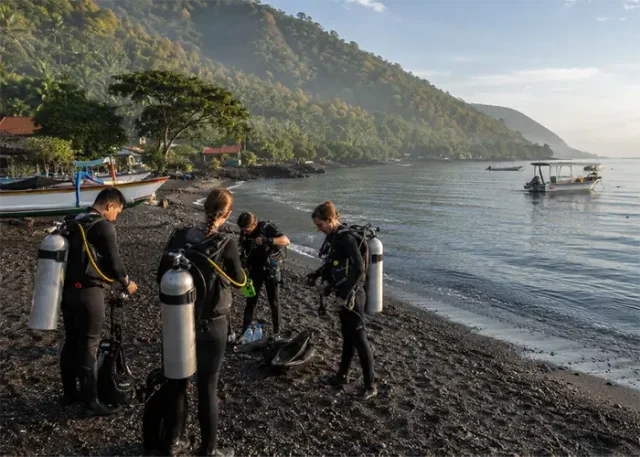
Twenty years ago, Amed was a row of salt-farming hamlets where the main industry was the evaporation of seawater in hollowed palm trunks. Today, it is shorthand for an entire 11-kilometer coastline of black-sand bays, and scuba diving in Amed, Bali, has become the anchor of the local economy without ever feeling industrial. There are no mega-resorts. Dive shops operate out of family compounds, boats are traditional jukung outriggers, and the morning commute to a dive site can be a two-minute walk across the beach.
What makes Amed unusual in the diving world is how much happens from shore:
- Jemeluk Bay offers a coral wall reachable by a short surface swim, busy with anthias, moray eels, and resident turtles.
- The Pyramids, an artificial reef project, shows how quickly marine life colonizes new structures, a living lesson for resort owners considering reef restoration.
- Lipah Bay hides a small wreck at recreational depth, draped in soft coral and frequented by schooling sweetlips.
- Bunutan Point delivers gentle drift dives over seafans where pygmy seahorses hide, for those with sharp eyes or sharper guides.
Why Shore Diving Changes the Economics of a Trip
Boat diving dominates most destinations, and boats mean schedules, fuel costs, and group sizes. Shore diving flips that. In Amed, a certified diver can complete three relaxed dives a day on a flexible timetable, which lowers costs for guests and raises margins for small operators. For Indonesian dive centers and resort clients studying the market, this is the quiet lesson of the east coast: infrastructure light, experience heavy.
Tulamben and the Wreck That Built a Region
Twenty minutes north of Amed lies Tulamben, home to the USAT Liberty, a 120-meter American cargo ship torpedoed in 1942 and pushed into the shallows by Agung’s 1963 eruption. It now rests between five and thirty meters of water, beginning just thirty steps from the beach. Ask any instructor in Indonesia to name the best scuba diving in Bali for a first wreck experience, and the Liberty will come up before the sentence ends.
The wreck deserves its reputation, but the area around it rewards patience:
- Coral Garden, next to the wreck, shelters garden eels, ribbon eels, and a resident school of bumphead parrotfish that sweeps through at dawn.
- The Drop-off, a wall at the bay’s eastern end, holds black coral bushes and passing pelagics.
- Seraya Secrets, just south, is muck diving at its finest: harlequin shrimp, frogfish, and nudibranchs that fill memory cards in a single dive.
Timing Matters More Than Most Visitors Realize
The bumpheads appear at first light. The wreck is silent at 7 a.m. and shoulder-to-shoulder by 10. Mola mola season runs roughly from July through October. A good operator builds the day around these rhythms, and travelers who understand them get a different island entirely.
What the East Coast Teaches the Hospitality Industry
I came to diving through hotels, not the other way around, and the East Coast has always struck me as a case study in restraint. The villages here grew an international reputation without surrendering their character. Homestays outnumber resorts. Local divemasters, many of them former fishermen, hold the institutional memory of every reef. Guests notice. Reviews from Amed and Tulamben mention names of guides and host families far more often than thread counts.
For resort operators elsewhere in Indonesia, the takeaway is worth stating plainly: the underwater asset is the product, and the community is the brand. Protect the first, invest in the second, and the marketing largely writes itself. The East Coast never ran a campaign. Divers did it for them, one logbook at a time.
The Quiet Case for Going East
Bali will always have two speeds. The South offers energy, nightlife, and convenience, and there is nothing wrong with wanting them. But the island rewards travelers who treat the airport as a starting line rather than a destination. Three hours east, the road narrows, Agung fills the windshield, and the sea turns the color of bottle glass.
Go for the wreck. Stay for the bumpheads at dawn, the salt farmers still working their palm trunks, and the strange calm of a coastline that figured out how to share its reefs without selling them. That, more than any single dive site, is what the east coast of Bali has to teach.