Utah’s Aquarius Trail Makes Backcountry Cycling More Inclusive
Multi-day bikepacking trips can be difficult to organize when members of a group have different fitness levels, riding styles or equipment. One cyclist may prefer technical singletrack, another may enjoy long gravel climbs, while someone else may rely on an e-bike to complete the same distance.
The Aquarius Trail Hut System in southern Utah addresses that challenge with multiple route options connected by five off-grid backcountry huts. Riders can choose trails suited to their abilities and interests before reuniting each evening at a shared destination.
The complete route covers approximately 190 miles between Brian Head and Escalante, passing through the landscapes of Utah’s Color Country. Along the way, riders encounter high-elevation forests, desert terrain, mountain roads and views extending toward Bryce Canyon and Grand Staircase-Escalante.
One Trail System, Several Ways to Ride
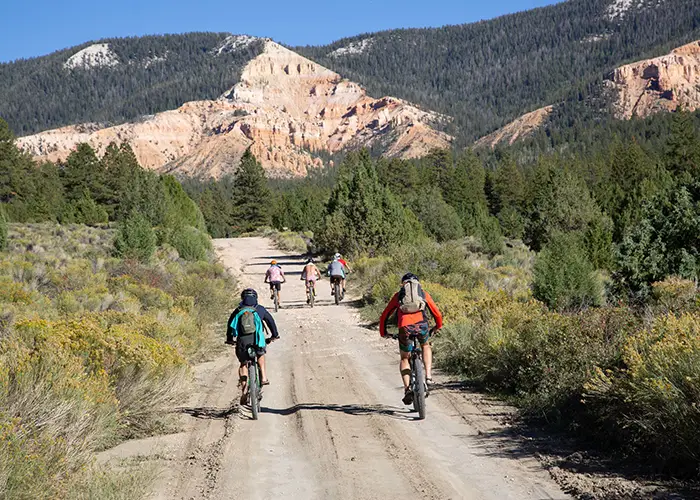
Rather than requiring everyone to follow exactly the same trail, the Aquarius system incorporates singletrack, gravel roads, doubletrack and ATV routes.
Experienced mountain bikers can seek out technical sections such as the Bunker Creek and Thunder Mountain trails. Gravel and endurance cyclists can follow a combination of high-alpine roads, dirt tracks and less technical alternatives across the Aquarius Plateau.
E-bike riders can also complete the journey using designated e-bike routes. Charging is available at each hut, allowing riders to prepare their batteries for the following day.
However, e-bikes are not permitted on every trail. Riders must follow the official e-bike route and avoid restricted singletrack sections on days one, three and five of the full itinerary. Groups should review the latest route information before departure rather than assuming that every cyclist can use the same trail each day.
Adaptive cyclists should contact the operator directly to discuss equipment, transportation and individual trail requirements. Conditions vary considerably, and not every part of the system will be suitable for every adaptive setup.
Connecting Different Generations and Abilities
The flexibility of the trail is changing the type of group that can consider a backcountry cycling trip.
According to Escape Adventures founder Jared Fisher, the system has attracted parents travelling with adult children, friends with different fitness levels and families using tandem bicycles.
“When we built the Aquarius Trail, the headlines were all about the huts themselves,” Fisher said. “But the real magic we’re seeing now is who is using them.”
Groups can separate during the day and choose different route configurations before meeting again at the same hut. This arrangement allows stronger riders to tackle technical terrain without requiring every member of the group to do the same.
It can also remove some of the pressure that develops when cyclists with different paces attempt to remain together for an entire day.
A Lighter Approach to Bikepacking
Traditional bikepacking requires riders to carry camping equipment, food, cooking supplies, bedding and repair tools. The resulting weight can make long climbs considerably more difficult and may discourage cyclists who are new to multi-day riding.
The Aquarius huts allow visitors to travel with a lighter load. Bedding, cooking facilities, food provisions and basic bicycle maintenance equipment are available along the route, eliminating the need to carry many of the heaviest items.
The full itinerary typically involves daily distances of approximately 25 to 40 miles. Although removing camping equipment makes the journey more manageable, it does not make it effortless. The route includes extended climbs, technical descents, high elevations and more than 17,000 feet of cumulative elevation gain.
Riders still need appropriate fitness, navigation skills and experience handling their chosen bicycle on remote terrain.
For a closer look at the complete route, see DRIFT Travel’s previous feature on the Aquarius Trail Hut System through the American West.
Inside the Aquarius Trail Huts
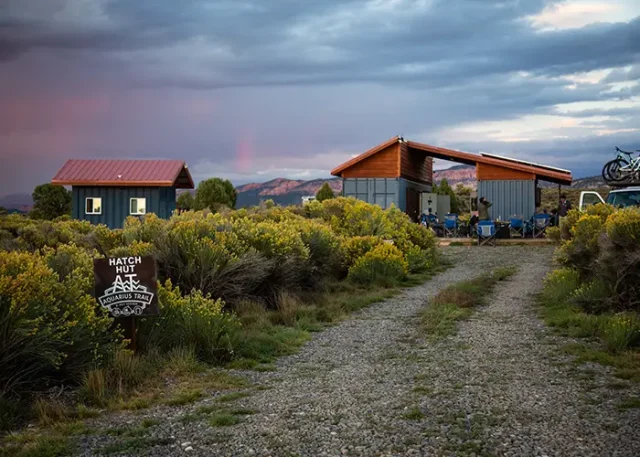
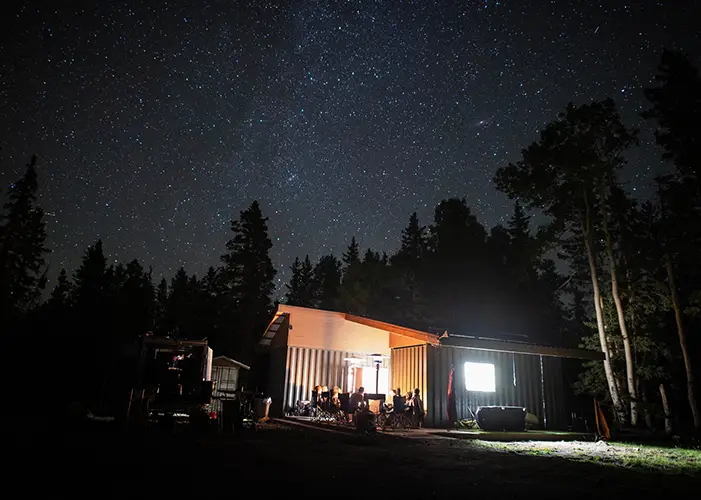
The five huts were constructed from repurposed shipping containers and designed to operate in remote locations with limited infrastructure.
Solar panels provide electricity for lighting, kitchen appliances and charging small electronic devices. E-bike batteries are charged using dedicated generators stored at the huts rather than the solar-powered interior outlets.
Each location includes sleeping cabins, a kitchen, refrigerator and freezer, hand-washing facilities, body-rinse stations and a Forest Service-approved pit toilet. Bicycle stands and repair tools are available for basic maintenance.
Outdoor spaces include large decks, hammocks and propane fire pits where groups can gather after the day’s ride. Because the huts are stocked with food and kitchen equipment, riders can prepare dinner and breakfast without carrying a stove or several days of provisions.
The huts accommodate shared groups, although private bookings may also be available. All stays must be reserved in advance.
Cycling From Brian Head to Escalante
The complete six-day route begins at Brian Head Peak, which rises to more than 11,000 feet. From there, cyclists descend through alpine terrain toward Panguitch Lake and the first hut near Hatch.
Subsequent stages travel through the forests and red-rock landscapes surrounding Red Canyon, Pine Lake and the Aquarius Plateau. Riders encounter volcanic terrain, ponderosa forests, open meadows, hoodoos and high desert along the way.
Possible highlights include Bunker Creek, Thunder Mountain, Powell Point, Hell’s Backbone and Calf Creek. The route eventually descends toward Escalante at an elevation of approximately 5,820 feet.
Travellers planning additional time in the region can find more ideas in DRIFT Travel’s guide to a spring adventure around Bryce Canyon and southern Utah.
Guided, Self-Guided and Shorter Trips
The Aquarius Trail can be experienced through self-guided or fully guided itineraries. The signature journey covers the entire 190-mile system over six days, while shorter and customized trips may be arranged for riders unable to complete the full route.
A guided departure may be preferable for cyclists unfamiliar with backcountry navigation, bicycle repairs or the challenges of riding at high elevation. Self-guided groups should be comfortable following digital route files and responding to mechanical problems, changing weather and unexpected trail conditions.
A suitable support vehicle is recommended, particularly for larger groups or those using different types of bicycles. Drivers can reach the huts and meet cyclists at the end of each stage.
When to Ride the Aquarius Trail
The complete trail is generally available from July through mid-October because snow can remain at higher elevations outside that period.
Weather can change quickly in southern Utah’s mountain environments. Riders should prepare for intense sun, cool evenings, thunderstorms and sudden drops in temperature. Rain or early snowfall can make sections of the route difficult or temporarily unrideable.
The high starting elevation may also affect travellers arriving from sea level. Spending time acclimatizing before beginning the route can make the first days more comfortable.
Even with stocked huts, riders should carry adequate water, layers, sun protection, navigation tools, a first-aid kit and essential repair supplies. Current trail conditions, fire restrictions and route closures should always be checked before departure.
For route maps and operating information, visit the Aquarius Trail Hut System.